ChatGPT vs Claude AI for Digital Marketing

ChatGPT vs Claude AI for Digital Marketing: Which One Should You Use?

ChatGPT vs Claude AI for Digital Marketing: Which One Should You Use?

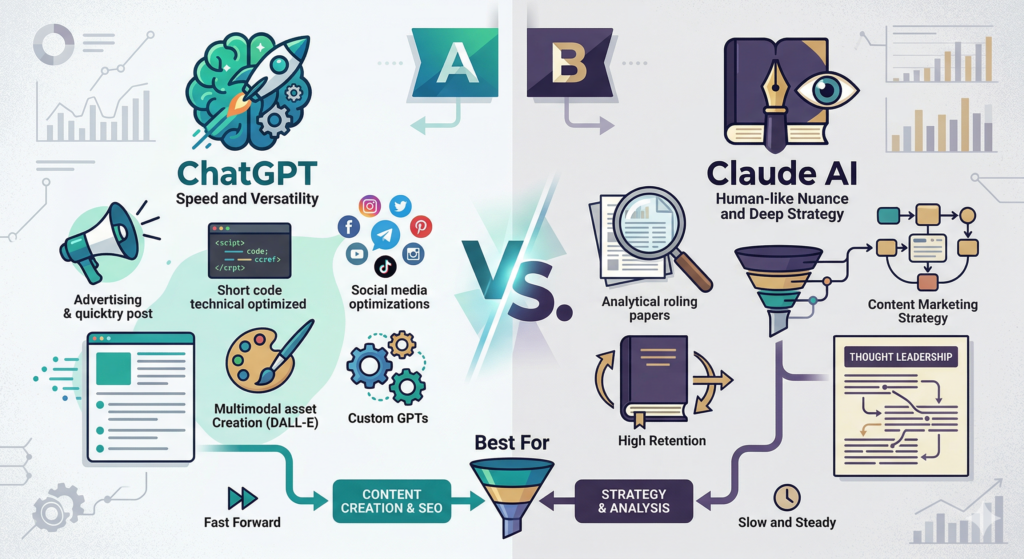
Artificial intelligence is transforming digital marketing, helping professionals create content, optimize SEO strategies, analyze data, and automate workflows. Two of the most popular AI tools today are ChatGPT and Claude. Both offer powerful features, but they work differently when applied to digital marketing tasks.

If you’re a marketer, blogger, or business owner, understanding the differences between ChatGPT and Claude AI can help you choose the right tool for your needs.

What is ChatGPT?

ChatGPT is an AI-powered conversational assistant designed to generate text, ideas, and solutions quickly. It is widely used in digital marketing for content creation, SEO optimization, keyword research, and social media planning.

ChatGPT Strengths for Digital Marketing

  • Fast content generation
  • SEO-friendly blog writing
  • Keyword research assistance
  • Social media caption creation
  • Ad copy generation
  • Email marketing content
  • Structured outlines and lists

ChatGPT is ideal for marketers who need quick, actionable outputs and structured content.

What is Claude AI?

Claude AI is another advanced AI assistant focused on detailed, thoughtful, and contextual responses. It is particularly useful for long-form content, strategy planning, and research-heavy marketing tasks.

Claude AI Strengths for Digital Marketing

  • Long-form content creation
  • In-depth marketing strategy
  • Detailed analysis
  • Brand voice development
  • Research-based writing
  • Content editing and refinement
  • Complex topic explanation

Claude AI is best suited for marketers who want comprehensive and contextual responses.

Content Writing Comparison

Content is one of the biggest areas where digital marketers use AI tools.

ChatGPT for Content Writing

ChatGPT excels at:

  • Blog outlines
  • Short articles
  • SEO-friendly content
  • Product descriptions
  • Landing page copy
  • Social media content

It usually provides structured responses with headings and bullet points, making it easy to publish quickly.

Claude AI for Content Writing

Claude AI is better for

  • Long-form blogs
  • In-depth guides
  • Thought leadership content
  • Analytical posts
  • Story-based marketing

It tends to generate more detailed explanations and more profound insights.

SEO and Keyword Research

Both tools support SEO, but their approach differs.

ChatGPT for SEO

ChatGPT works well for:

  • Generating keyword lists
  • Creating meta descriptions
  • Writing SEO-friendly blogs
  • Generating FAQ sections
  • On-page SEO suggestions

It is efficient for quick SEO tasks and optimization.

Claude AI for SEO

Claude AI performs better for

  • Topic clustering
  • Content strategy planning
  • Search intent analysis
  • Long-tail keyword variations
  • Comprehensive SEO content

It focuses more on strategy than speed.

Social Media Marketing

Social media content creation is another key area.

ChatGPT for Social Media

ChatGPT helps with:

  • Instagram captions
  • Facebook posts
  • LinkedIn content
  • Hashtag suggestions
  • Short promotional text

It is excellent for quick daily posting.

Claude AI for Social Media

Claude AI helps with:

  • Content calendar planning
  • Brand voice consistency
  • Long captions
  • Audience-focused messaging
  • Campaign storytelling

It is useful for planned marketing campaigns.

Google Ads and Ad Copy

AI tools are also useful for paid advertising.

ChatGPT for Ads

ChatGPT can generate:

  • Google Ads headlines
  • Meta Ads copy
  • Call-to-action phrases
  • A/B testing variations

It works well for quick ad creation.

Claude AI for Ads

Claude AI helps with:

  • Ad strategy planning
  • Audience targeting ideas
  • Funnel-based messaging
  • Detailed campaign structure

It focuses more on advertising strategy.

Blogging and Website Content

For bloggers and website owners, choosing the right AI matters.

ChatGPT is better for:

  • Quick blog posts
  • SEO-optimized articles
  • Topic ideas
  • Internal linking suggestions

Claude AI is better for

  • Pillar content
  • Evergreen guides
  • In-depth tutorials
  • Content expansion

Using both together can create a powerful blogging strategy.

Ease of Use

ChatGPT is:

  • Faster
  • More structured
  • Beginner-friendly
  • Ideal for quick tasks

Claude AI is

  • More detailed
  • Context-focused
  • Better for advanced users
  • Ideal for research

Which One is Better for Digital Marketing?

The answer depends on your goals.

Choose ChatGPT if you want:

  • Fast content creation
  • SEO blog writing
  • Social media posts
  • Quick marketing ideas
  • Ad copy generation

Choose Claude AI if you want:

  • Detailed marketing strategy
  • Long-form content
  • Research-based articles
  • Brand voice development
  • Content planning

Best Strategy: Use Both Together

Many digital marketers combine both tools:

  • Use ChatGPT for quick drafts
  • Use Claude AI for expanding content
  • Use ChatGPT for SEO keywords
  • Use Claude AI for content depth
  • Use ChatGPT for social posts
  • Use Claude AI for campaign strategy

This combination improves productivity and content quality.

Conclusion

Both ChatGPT and Claude AI are powerful tools for digital marketing. ChatGPT is ideal for speed, structure, and SEO-friendly content, while Claude AI excels in depth, strategy, and long-form writing. The best approach is to understand your marketing needs and use the tool that fits your workflow. For maximum results, combining both can help you create high-quality content, improve SEO, and build a strong digital presence.

ChatGPT vs Claude AI for Digital Marketing: Which One Should You Use? Read More »

Freelance SEO Pay in India: Income, Rates, and Growth Opportunities

Freelance SEO Pay in India: Income, Rates, and Growth Opportunities

Freelance SEO has become one of the most popular online careers in India. With more businesses going digital, the demand for SEO experts is increasing rapidly. Many beginners want to know how much they can earn as a freelance SEO professional and what growth opportunities are available. In this guide, we will explain freelance SEO pay in India, income potential, rates, and career growth in simple and easy-to-understand language.

What is Freelance SEO?

Freelance SEO means working independently and offering search engine optimization services to clients. Instead of working full-time in a company, SEO freelancers handle projects for multiple clients and earn money based on their skills and experience.

Freelance SEO professionals help businesses:

  • Improve website ranking
  • Increase organic traffic
  • Optimize website content
  • Build backlinks
  • Perform keyword research
  • Improve technical SEO

As businesses rely more on online visibility, freelance SEO opportunities are growing in India.

Freelance SEO Income in India

Freelance SEO income in India depends on several factors such as experience, skills, niche, and client type. Beginners may start with smaller projects, while experienced freelancers earn higher monthly income.

Here is a general idea of freelance SEO earnings in India:

  • Beginner (0–1 year): ₹10,000 – ₹30,000 per month
  • Intermediate (1–3 years): ₹30,000 – ₹70,000 per month
  • Experienced (3–5 years): ₹70,000 – ₹1,50,000 per month
  • Expert (5+ years): ₹1,50,000 – ₹3,00,000+ per month

These numbers can vary depending on workload and client quality. Some freelancers earn even more by working with international clients.

Freelance SEO Rates in India

SEO freelancers charge clients in different ways. The most common pricing models include:

Hourly Rate

Many freelancers charge hourly rates based on experience.

  • Beginner: ₹300 – ₹800 per hour
  • Intermediate: ₹800 – ₹1500 per hour
  • Expert: ₹1500 – ₹4000 per hour

Monthly Retainer

This is the most common pricing model for SEO services.

  • Small business SEO: ₹8,000 – ₹20,000 per month
  • Medium business SEO: ₹20,000 – ₹50,000 per month
  • Advanced SEO services: ₹50,000 – ₹1,00,000+ per month

Project-Based Pricing

Freelancers also charge per project:

  • Website SEO audit: ₹5,000 – ₹25,000
  • On-page SEO setup: ₹7,000 – ₹30,000
  • Local SEO optimization: ₹10,000 – ₹40,000
  • Full SEO project: ₹25,000 – ₹1,00,000+

Pricing increases as your experience grows.

Factors That Affect Freelance SEO Pay

Several factors influence how much you can earn as a freelance SEO expert:

1. Experience

More experience leads to higher income. Clients prefer freelancers with proven results.

2. Skills

Freelancers who know technical SEO, content SEO, and link building earn more.

3. Client Location

International clients usually pay higher than local clients.

4. Niche Expertise

Specializing in niches like eCommerce SEO or local SEO increases rates.

5. Portfolio

Strong case studies help attract high-paying clients.

How Beginners Can Start Earning from Freelance SEO

If you are a beginner, follow these steps to start earning:

  • Learn SEO basics
  • Practice on your own website
  • Create portfolio
  • Offer services at lower price initially
  • Join freelance platforms
  • Reach out to small businesses
  • Build client relationships

Starting small helps you gain experience and grow income.

Best Freelance SEO Services That Pay Well

Some SEO services offer higher earning potential:

  • Website SEO audit
  • Local SEO optimization
  • Keyword research
  • Technical SEO fixes
  • Content optimization
  • Backlink building
  • Competitor analysis

Offering multiple services increases your income.

Freelance SEO Growth Opportunities in India

Freelance SEO offers excellent career growth. As you gain experience, you can expand your services and increase earnings.

Growth opportunities include:

  • Becoming SEO consultant
  • Starting SEO agency
  • Offering digital marketing services
  • Teaching SEO courses
  • Selling SEO tools or templates
  • Working with international clients

Freelancers have flexibility to scale income.

Advantages of Freelance SEO Career

Freelance SEO is popular because of many benefits:

  • Work from home
  • Flexible schedule
  • Unlimited earning potential
  • No investment required
  • Multiple clients
  • Skill-based growth

These advantages make freelance SEO a great career option.

Challenges in Freelance SEO

Although freelance SEO has many benefits, there are some challenges:

  • Finding clients initially
  • Managing multiple projects
  • SEO results take time
  • Competition from other freelancers
  • Continuous learning required

With consistency, these challenges can be managed.

Tips to Increase Freelance SEO Income

To grow your freelance SEO pay:

  • Build strong portfolio
  • Learn advanced SEO techniques
  • Focus on results
  • Improve communication skills
  • Target international clients
  • Offer monthly SEO packages
  • Build personal brand

These strategies help increase earning potential.

Freelance SEO vs Full-Time Job Salary

Many freelancers compare freelance income with full-time jobs. Freelance SEO offers more earning potential because:

  • No salary limit
  • Multiple clients
  • Flexible pricing
  • Global opportunities

However, freelancers must manage their own workflow.

Is Freelance SEO a Good Career in India?

Yes, freelance SEO is a great career option in India. Demand for SEO services is growing as businesses move online. With the right skills and consistency, freelancers can earn a stable monthly income and build long-term career growth.

Conclusion

Freelance SEO pay in India varies depending on experience, skills, and clients. Beginners can start earning ₹10,000 to ₹30,000 per month, while experienced freelancers can earn ₹1,00,000 or more. SEO freelancers can charge hourly, monthly, or project-based rates. With continuous learning, strong portfolio, and client relationships, income can grow significantly.

Freelance SEO also offers excellent growth opportunities, including starting an agency or working with global clients. If you are interested in digital marketing, freelance SEO can be a rewarding career with flexible work and unlimited earning potential.

Freelance SEO Pay in India: Income, Rates, and Growth Opportunities Read More »

SEO freelancer Near Me

SEO Freelancer Near Me – How to Find the Right Expert for Your Business

SEO Freelancer Near Me – How to Find the Right Expert for Your Business

If you are searching for SEO freelancer near me, you are probably looking for someone who can help improve your website ranking and increase online visibility. Hiring a local SEO freelancer can be a smart choice, especially for small businesses that want personalized attention and targeted strategies. In this guide, we will explain what an SEO freelancer does, why hiring a local expert is beneficial, and how you can find the right one easily.

What is an SEO Freelancer?

An SEO freelancer is an independent professional who helps websites rank higher on search engines like Google. Unlike agencies, freelancers usually work directly with clients and provide customized SEO services based on business needs.

SEO freelancers handle various tasks such as:

  • Keyword research
  • On-page SEO optimization
  • Technical SEO improvements
  • Content optimization
  • Link building
  • Website audit
  • Competitor analysis

Their main goal is to increase organic traffic and improve search engine rankings.

Why Search for “SEO Freelancer Near Me”?

Many businesses prefer hiring a local SEO freelancer because they understand the local market and customer behavior. Searching for “SEO freelancer near me” helps you find professionals who are familiar with your location and target audience.

Benefits of hiring a local SEO freelancer:

  • Better communication
  • Understanding of local audience
  • Knowledge of local keywords
  • Personalized strategy
  • Easier collaboration
  • Affordable pricing compared to agencies

Local SEO freelancers can also help optimize your business for location-based searches.

Services Offered by an SEO Freelancer

When you hire an SEO freelancer, you can expect the following services:

1. Keyword Research

The freelancer identifies relevant keywords your customers search for. This helps target the right audience and improve ranking.

2. On-Page SEO

This includes optimizing title tags, meta descriptions, headings, and content. Proper on-page SEO helps search engines understand your website.

3. Technical SEO

Technical SEO focuses on improving website performance, mobile-friendliness, and site structure.

4. Content Optimization

SEO freelancers improve your website content by adding keywords and making it user-friendly.

5. Link Building

They build quality backlinks from trusted websites to improve domain authority.

6. Local SEO

Local SEO helps your business appear in local search results such as “SEO services near me” or “digital marketing near me.”

How to Find the Best SEO Freelancer Near You

Finding the right SEO freelancer is important for achieving good results. Here are simple steps:

Step 1: Search on Google

Search using keywords like:

  • SEO freelancer near me
  • Local SEO expert near me
  • Freelance SEO services in your city

Check top-ranking websites and profiles.

Step 2: Check Portfolio

Review their past work, case studies, and results. A good freelancer should show examples of ranking improvements.

Step 3: Read Reviews

Look for client reviews and testimonials. Positive feedback indicates reliability.

Step 4: Ask About Strategy

Ask how they plan to improve your website ranking. Avoid freelancers who promise instant results.

Step 5: Compare Pricing

Compare different freelancers and choose one that fits your budget and requirements.

Advantages of Hiring an SEO Freelancer

Hiring an SEO freelancer offers many benefits:

  • Cost-effective compared to agencies
  • Direct communication
  • Flexible working hours
  • Customized SEO strategies
  • Faster response time
  • Focused attention on your project

Freelancers usually provide more personalized service.

When Should You Hire an SEO Freelancer?

You should hire an SEO freelancer when:

  • Your website is not ranking on Google
  • You want more organic traffic
  • You need local SEO services
  • You want affordable SEO solution
  • You want to grow your business online

SEO freelancers are suitable for small businesses, startups, and bloggers.

Questions to Ask Before Hiring

Before hiring an SEO freelancer, ask these questions:

  • What SEO tools do you use?
  • How long will it take to see results?
  • Do you provide monthly reports?
  • What is your SEO strategy?
  • Do you follow Google guidelines?

These questions help you choose the right expert.

Cost of Hiring SEO Freelancer

SEO freelancer pricing varies based on experience and services. Some freelancers charge:

  • Hourly rate
  • Monthly package
  • Project-based pricing

Beginners usually charge less, while experienced freelancers charge more. Choose based on quality, not just price.

Tips for Working with an SEO Freelancer

To get the best results:

  • Share your business goals
  • Provide website access
  • Communicate regularly
  • Review monthly reports
  • Be patient with SEO results

SEO takes time, but consistent efforts bring long-term growth.

Common Mistakes to Avoid

Avoid these mistakes when hiring:

  • Choosing cheapest option
  • Expecting instant results
  • Ignoring experience
  • Not checking reviews
  • Not discussing strategy

Selecting the right freelancer ensures better outcomes.

Conclusion

Searching for “SEO freelancer near me” is a smart step if you want to improve your website ranking and grow your online presence. A local SEO freelancer can provide personalized strategies, better communication, and affordable services. By checking portfolio, reviews, and strategy, you can find the right expert for your business.

SEO is a long-term investment, and hiring a skilled freelancer can help increase organic traffic, improve visibility, and generate more leads. Choose wisely, stay consistent, and your website can achieve better rankings and business growth.

SEO Freelancer Near Me – How to Find the Right Expert for Your Business Read More »

AEO vs GEO: Which Strategy Should You Focus

AEO vs GEO: Which Strategy Should You Focus on in 2026?

AEO vs GEO: Which Strategy Should You Focus on in 2026?

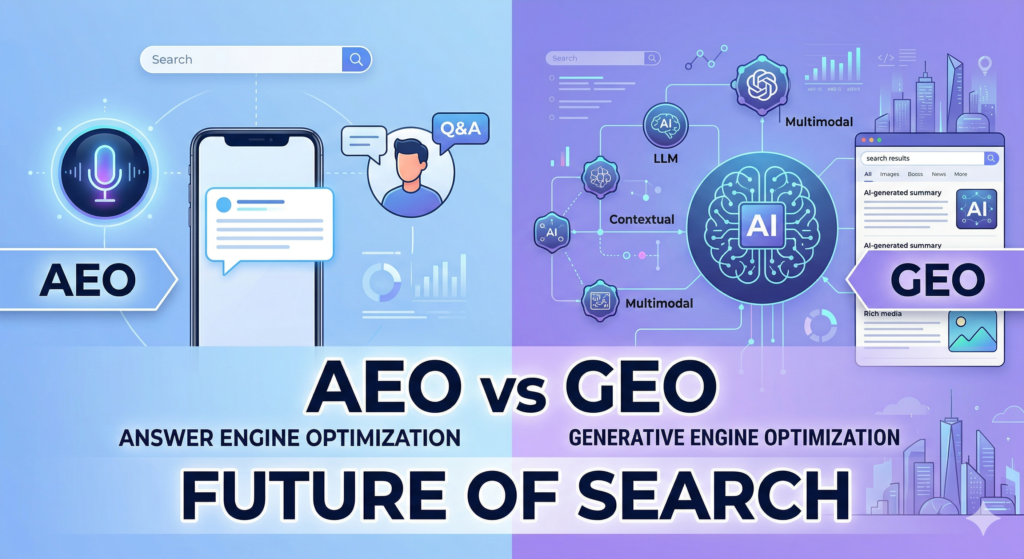
Digital marketing is evolving quickly, and new strategies are emerging to help businesses stay visible online. Two of the latest trends are AEO (Answer Engine Optimization) and GEO (Generative Engine Optimization). Many beginners and business owners are now asking which one they should focus on in 2026. Both strategies aim to improve online visibility, but they work in different ways. This guide explains AEO vs GEO in simple terms so you can decide the best strategy for your website.

What is AEO?

AEO stands for Answer Engine Optimization. It focuses on optimizing content to provide direct answers to user queries. Instead of just ranking on search engine results pages, AEO helps your content appear in featured snippets, voice search results, and AI-generated answers.

When users ask questions on Google, voice assistants, or AI tools, AEO helps your content become the selected answer. The goal is to provide clear, concise, and helpful information.

Key Features of AEO

  • Focus on question-based keywords
  • Optimized for featured snippets
  • Voice search optimization
  • Structured content format
  • FAQ sections
  • Clear and concise answers

AEO is growing because more users now ask direct questions instead of typing short keywords.

What is GEO?

GEO stands for Generative Engine Optimization. It is a newer strategy that focuses on optimizing content for AI-powered search engines. These generative engines use artificial intelligence to generate answers by combining information from multiple sources.

Instead of showing a list of websites, generative engines provide summarized responses. GEO helps your content become part of those AI-generated answers.

Key Features of GEO

  • AI-friendly content structure
  • Semantic keyword usage
  • Topic-based content clusters
  • High-quality informational content
  • Authoritative content creation
  • Natural language writing

GEO is becoming important as AI-driven search platforms continue to grow.

AEO vs GEO: Main Differences

1. Focus Area

AEO focuses on answering specific questions directly. GEO focuses on creating comprehensive content that AI tools use to generate answers.

AEO is about quick answers, while GEO is about detailed knowledge.

2. Search Experience

AEO helps your content appear in featured snippets and voice search. GEO helps your content appear in AI-generated responses.

Both improve visibility, but they target different search experiences.

3. Content Style

AEO requires short, structured, and direct answers. GEO requires in-depth, detailed, and context-rich content.

For AEO, short paragraphs work well. For GEO, long-form content performs better.

4. Keyword Strategy

AEO focuses on question-based keywords such as the following:

  • What is digital marketing
  • How to rank website
  • Why SEO is important

GEO focuses on semantic keywords and related topics within a broader subject.

5. Future Relevance

AEO is already widely used in search engines. GEO is emerging as AI search continues to evolve.

Both strategies are important for future SEO success.

Benefits of AEO

AEO offers several advantages:

  • Helps appear in featured snippets
  • Improves voice search visibility
  • Increases click-through rate
  • Provides quick answers to users
  • Enhances user experience

AEO is especially helpful for beginner websites looking for faster visibility.

Benefits of GEO

GEO also provides strong benefits:

  • Optimized for AI-powered search
  • Builds topical authority
  • Improves long-term ranking
  • Supports comprehensive content
  • Increases credibility

GEO is ideal for websites that want to build authority in their niche.

When Should You Focus on AEO?

You should focus on AEO if:

  • You want quick visibility
  • You target question-based queries
  • You write how-to content
  • You want featured snippets
  • You optimize for voice search

AEO is great for blogs, FAQs, and informational content.

When Should You Focus on GEO?

You should focus on GEO if:

  • You want long-term SEO growth
  • You create detailed content
  • You build topical authority
  • You target AI-driven search
  • You publish in-depth guides

GEO is suitable for blogs, agencies, and knowledge-based websites.

Can You Use AEO and GEO Together?

Yes, the best approach in 2026 is to combine both strategies. AEO and GEO work better when used together.

For example:

  • Write detailed content for GEO
  • Add short answers inside for AEO
  • Include FAQ sections
  • Use structured headings
  • Optimize for AI search

Combining both improves overall visibility.

Best Content Strategy for 2026

Here is a simple strategy:

  • Create long-form content
  • Use question-based headings
  • Add short answers below headings
  • Use natural language
  • Add related subtopics
  • Include FAQ section

This method supports both AEO and GEO.

Practical Example

If your topic is “Digital Marketing Strategy,” you can:

  • Write detailed guide (GEO)
  • Add “What is digital marketing?” section (AEO)
  • Include FAQ questions (AEO)
  • Cover related subtopics (GEO)

This approach improves visibility in both traditional and AI search.

Which is Better in 2026?

Both AEO and GEO are important in 2026. AEO helps with quick answers and featured snippets, while GEO helps with AI-generated search results and long-term authority.

If you are a beginner, start with AEO because it is easier to implement. Once your website grows, focus on GEO for long-term success.

Conclusion

AEO and GEO are two powerful strategies shaping the future of digital marketing. AEO focuses on providing direct answers and improving visibility in featured snippets and voice search. GEO focuses on optimizing content for AI-driven search engines and building topical authority.

In 2026, the best approach is to combine both strategies. Create detailed, high-quality content while also providing clear and concise answers. By using AEO and GEO together, you can improve your chances of ranking in search engines and appearing in AI-generated results. This balanced strategy will help your website stay competitive and grow in the evolving digital landscape.

AEO vs GEO: Which Strategy Should You Focus on in 2026? Read More »

 How to Rank Website on Google First Page

How To Rank Website On Google First Page – Complete Beginner Guide

How to Rank Website on Google First Page—Complete Beginner’s Guide

Ranking your website on the first page of Google is one of the most effective ways to get traffic, leads, and customers. Most users never go beyond the first page, which makes it important for businesses and bloggers to optimize their websites properly. If you are a beginner, don’t worry. This guide explains how to rank your website on Google’s first page in simple and easy-to-understand steps. How to Rank Website on Google First Page

Why Ranking on Google’s First Page is Important

When your website appears on the first page of Google, it increases visibility and credibility. People trust websites that appear at the top of search results. Higher ranking also means more clicks, more traffic, and better chances of conversions.

Benefits of ranking on the first page: How to Rank Website on Google First Page

  • More organic traffic
  • Better brand visibility
  • Increased trust and credibility
  • Higher leads and sales
  • Long-term marketing benefits

Step 1: Choose the Right Keywords

Keywords are the foundation of search engine optimization. They help Google understand what your content is about. You should choose keywords that people are actually searching for.

Tips for keyword research:

  • Use long-tail keywords
  • Focus on low-competition keywords
  • Choose keywords related to your niche
  • Check search volume
  • Use question-based keywords

For example, instead of targeting “SEO,” target “how to rank a website on the first page.”

Step 2: Create High-Quality Content

Content plays a major role in ranking your website. Google prefers helpful and informative content that solves user problems.

Tips for writing SEO-friendly content:

  • Write for users first
  • Use simple language
  • Add headings and subheadings
  • Include keywords naturally
  • Write detailed content
  • Use bullet points
  • Add images

Long-form content usually performs better because it provides complete information.

Step 3: Optimize Title and Meta Description

Your title tag and meta description help search engines understand your page and attract clicks.

Best practices:

  • Include main keyword in title
  • Keep title under 60 characters
  • Write compelling meta description
  • Add keywords naturally in the description.

A good title improves click-through rate, which can help improve ranking.

Step 4: Use Proper Heading Structure

Using headings improves readability and SEO. Organize content using H1, H2, and H3 tags.

Example:

  • H1 for main title
  • H2 for main sections
  • H3 for sub-sections

This helps search engines understand your content structure.

Step 5: Improve Website Loading Speed

Website speed is an important ranking factor. A slow website can reduce user experience and increase bounce rate.

Ways to improve speed:

  • Compress images
  • Use caching plugin
  • Choose fast hosting
  • Use lightweight theme
  • Minimize plugins

A fast-loading website improves both SEO and user experience.

Step 6: Make Your Website Mobile-Friendly

Most users browse websites on mobile devices. Google also uses mobile-first indexing.

Tips:

  • Use responsive design
  • Check mobile layout
  • Optimize images
  • Use readable fonts

Mobile-friendly websites rank better on Google.

Step 7: Optimize Images

Images make content engaging, but they should be optimized for SEO.

Best practices:

  • Use compressed images
  • Add alt text
  • Use descriptive file names
  • Use proper size

Image optimization improves page speed and ranking.

Step 8: Build Quality Backlinks

Backlinks are links from other websites to your site. They act as votes of trust for search engines.

Ways to build backlinks:

  • Guest posting
  • Blog commenting
  • Directory submission
  • Social sharing
  • Creating shareable content

Quality backlinks improve domain authority and ranking.

Step 9: Use Internal Linking

Internal links connect pages within your website. They help users navigate and improve SEO.

Benefits:

  • Improves crawlability
  • Reduces bounce rate
  • Distributes link authority
  • Keeps users longer on site

Link related posts naturally in your content.

Step 10: Optimize for On-Page SEO

On-page SEO helps search engines understand your content.

Checklist:

  • Use keyword in title
  • Use keyword in first paragraph
  • Add keyword in headings
  • Use keyword naturally in content
  • Add internal links
  • Add external links

Avoid keyword stuffing, as it can harm your ranking.

Step 11: Publish Content Regularly

Google prefers websites that update regularly. Posting new content signals that your website is active.

Tips:

  • Publish blog posts weekly
  • Update old content
  • Add new information
  • Improve existing articles

Consistency helps improve ranking over time.

Step 12: Use Social Media to Promote Content

Social media helps drive traffic and increase visibility. Sharing your content increases chances of backlinks.

You can share on:

  • Facebook
  • Instagram
  • LinkedIn
  • Twitter

More traffic can indirectly improve ranking.

Step 13: Improve User Experience

Google ranks websites that provide good user experience.

Focus on:

  • Easy navigation
  • Clean design
  • Fast loading
  • Mobile friendly
  • Clear structure

Good user experience reduces bounce rate and improves ranking.

Step 14: Track Your Performance

Tracking helps you understand what works and what needs improvement.

Use tools to track:

  • Website traffic
  • Keyword ranking
  • Bounce rate
  • Click-through rate

Analyzing data helps improve your SEO strategy.

Common Mistakes to Avoid

Avoid these mistakes:

  • Keyword stuffing
  • Duplicate content
  • Slow website
  • Poor mobile design
  • Low-quality backlinks
  • Ignoring user experience

Fixing these issues can improve ranking faster.

Conclusion

Ranking your website on Google’s first page requires proper SEO strategy, high-quality content, and consistency. Start by choosing the right keywords, creating helpful content, and optimizing your website for speed and mobile users. Build quality backlinks, improve user experience, and update your content regularly.

SEO takes time, but with the right approach, you can achieve higher rankings and steady organic traffic. By following these simple steps, beginners can improve their chances of ranking on the first page of Google and growing their online presence successfully.

How To Rank Website On Google First Page – Complete Beginner Guide Read More »
SEO vs Social Media Marketing

SEO vs Social Media Marketing

SEO vs Social Media Marketing – Which is Better for Beginners?

Digital marketing offers many ways to promote a business online, but two of the most popular methods are SEO and Social Media Marketing. Beginners often get confused about which one is better and where they should start. Both strategies help increase website traffic, brand awareness, and leads, but they work differently. In this guide, we will compare SEO vs Social Media Marketing in simple terms so beginners can choose the best option.

What is SEO?

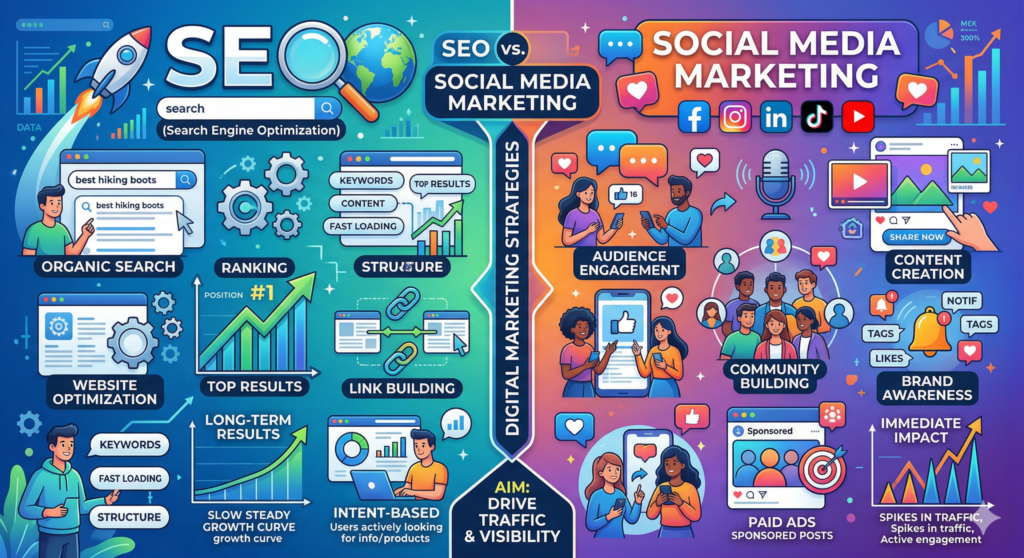
SEO stands for Search Engine Optimization. It is the process of optimizing your website so it ranks higher on search engines like Google. When people search for keywords related to your business, your website appears in search results.

For example, if someone searches digital marketing services, SEO helps your website show on the first page. The main goal of SEO is to get organic traffic without paying for ads.

Key Elements of SEO

  • Keyword research
  • On-page optimization
  • Technical SEO
  • Content creation
  • Backlink building
  • Website speed optimization

SEO is a long-term strategy that builds trust and authority over time.

What is Social Media Marketing?

Social media marketing involves promoting your business on platforms like Facebook, Instagram, LinkedIn, and Twitter. It helps you connect directly with your audience and build brand awareness.

Businesses use social media to share posts, videos, stories, and promotions. Social media marketing can generate quick traffic and engagement.

Key Elements of Social Media Marketing

  • Creating social media profiles 
  • Posting engaging content
  • Using hashtags
  • Running ads
  • Interacting with followers
  • Sharing images and videos

Social media marketing focuses on engagement and brand visibility.

SEO vs Social Media Marketing: Major Differences

1. Traffic Source

SEO brings traffic from search engines. Users visit your website when they search for something. This traffic is highly targeted because users already have intent.

Social media marketing brings traffic from social platforms. People may not always be searching for your services, but they discover your brand through posts.

2. Time to See Results

SEO takes time. It may take weeks or months to rank your website. However, once your site ranks, it can bring consistent traffic.

Social media marketing gives faster results. A single viral post can bring instant traffic and engagement.

3. Cost

SEO mainly requires time and effort. You can do SEO without spending money, although tools may help.

Social media marketing can be free, but many businesses use paid ads to increase reach. Ads require a budget.

4. Long-Term Benefits

SEO offers long-term benefits. A well-optimized blog can generate traffic for years.

Social media posts have a short life. Engagement usually decreases after a few days.

5. Audience Engagement

SEO focuses more on search traffic. Interaction happens when users visit your website.

Social media marketing allows direct interaction. You can reply to comments, messages, and build relationships.

Advantages of SEO for Beginners

SEO is beneficial for beginners because:

  • It brings free organic traffic
  • Builds website authority
  • Helps long-term growth
  • Improves brand credibility
  • Generates high-quality leads

If your goal is to grow your website and get consistent traffic, SEO is a strong option.

Advantages of Social Media Marketing for Beginners

Social media marketing is also useful for beginners because:

  • Easy to start
  • No technical knowledge required
  • Quick visibility
  • Helps build brand awareness
  • Encourages direct communication

If you want quick engagement and brand visibility, social media marketing is helpful.

When Should Beginners Choose SEO?

Beginners should focus on SEO when:

  • They have a website or blog
  • They want long-term traffic
  • They want to rank on Google
  • They are willing to wait for results
  • They want organic leads

SEO is ideal for bloggers, service providers, and businesses with websites.

When Should Beginners Choose Social Media Marketing?

Beginners should focus on social media marketing when:

  • They want quick traffic
  • They don’t have a website yet
  • They want brand awareness
  • They want to interact with customers
  • They promote visual products

Social media marketing works well for small businesses, influencers, and startups.

Can You Use Both SEO and Social Media Marketing?

Yes, the best strategy is to use both. SEO and social media marketing work better together.

For example:

  • Write SEO-friendly blog posts
  • Share blog posts on social media
  • Drive traffic from social platforms
  • Increase engagement
  • Improve brand visibility

Using both strategies helps maximize online growth.

Which is Easier for Beginners?

Social media marketing is easier to start. You can create an account and start posting immediately.

SEO requires learning keywords, content writing, and optimization. However, once you learn SEO basics, it becomes easier.

Which Brings Better Results?

Both methods give good results, but it depends on your goal.

If your goal is long-term traffic, SEO is better.
If your goal is quick visibility, social media marketing is better.
If your goal is business growth, use both together.

Best Strategy for Beginners

Here is a simple strategy:

  • Start with social media marketing
  • Build audience and awareness
  • Create a website
  • Start SEO optimization
  • Share content on social media
  • Combine both methods

This approach gives both quick and long-term results.

Conclusion

SEO and Social Media Marketing are both powerful digital marketing strategies. SEO helps you get long-term organic traffic and build website authority, while social media marketing provides quick visibility and engagement. For beginners, social media marketing is easier to start, but SEO offers better long-term benefits.

The best approach is to combine both strategies. Use SEO to rank your website on search engines and social media marketing to promote your content and connect with your audience. By using both methods together, beginners can grow their online presence, increase traffic, and generate more leads effectively.

SEO vs Social Media Marketing Read More »

Winning the Digital Toss: Why SEO

Winning the Digital Toss: Why SEO is the Opening Partnership Your Business Needs

Winning the Digital Toss: Why SEO is the Opening Partnership Your Business Needs.

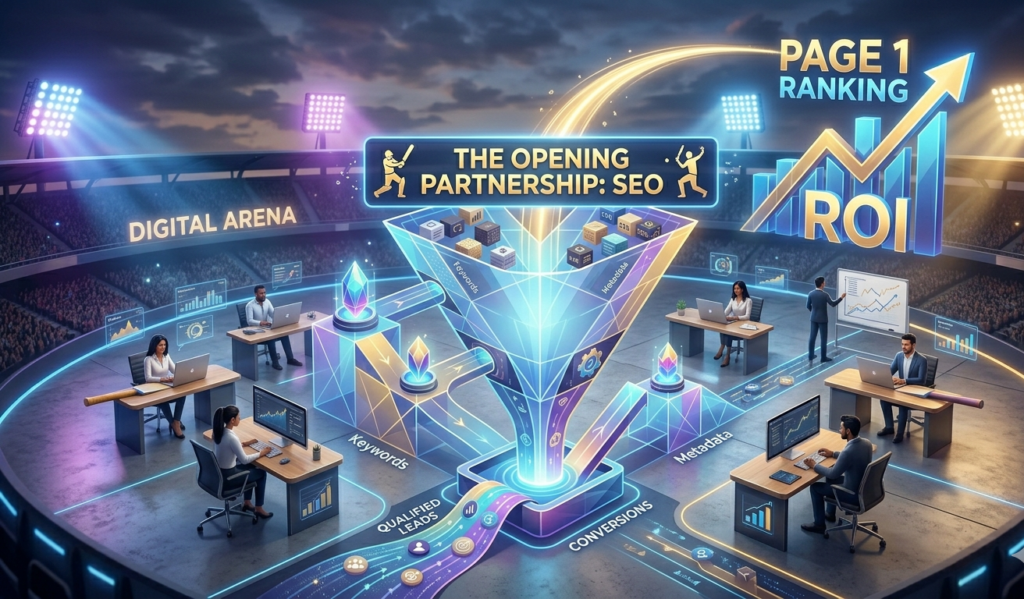
In the high-stakes world of the IPL, the “Opening Partnership” sets the tone for the entire innings. If your openers provide a solid start, the middle order can play with freedom, and the finishers can clear the boundary. But if you lose early wickets, you’re constantly playing catch-up.

Digital marketing is no different. Your business is the team, and the internet is the stadium. If you want to post a match-winning total (your revenue goals), you need a world-class opening partnership.

At Rachna Digital Hub, we believe SEO (Search Engine Optimization) is that vital opening pair. Winning the digital toss: why Search engine optimization? Because it provides the stability, the visibility, and the momentum your brand needs to dominate the marketplace. Here is the strategic blueprint for winning the digital toss and building an innings that lasts.


1. The Powerplay: Why Early Visibility is Non-Negotiable

In cricket, the Powerplay is the best time to score. With only two fielders outside the circle, every gap is an opportunity. In the digital world, the “Powerplay” happens every time a user types a query into Google. They are looking for an immediate solution, and if you aren’t in the top three results, you aren’t even on the field.

  • Winning the Toss: Having a technically sound website (fast loading, mobile-friendly, secure) is like winning the toss and choosing to bat on a flat track. It gives you the immediate advantage.

  • Exploiting the Gaps: Keyword research is the art of finding “gaps in the field.” We identify the specific terms your customers are using that your competitors have overlooked. By targeting these, you score “easy boundaries” (low-competition, high-intent traffic).

If you miss the Powerplay, you spend the rest of the game struggling to reach a competitive total. SEO ensures you start every “innings” with maximum momentum.


2. Building the Partnership: Content and Intent Alignment

A great opening partnership isn’t just about one person hitting sixes; it’s about two players understanding each other. In SEO, this partnership is between High-Quality Content and User Intent.

If your content doesn’t match what the user is actually looking for, you’ll get “run out.” Google’s sophisticated 2026 algorithms are like world-class umpires—they see everything. They can tell if a user is satisfied with your page or if they “bounced” back to the search results.

  • The Defensive Stroke (Technical SEO): Sometimes, you have to defend a good ball. Technical SEO—fixing broken links, optimizing image alt-text, and refining site architecture—protects your site from “wickets” (Google penalties or ranking drops).

  • The Aggressive Drive (Content Authority): To move the score along, you need authoritative content. We build “Topic Clusters” that demonstrate to Google that you aren’t just a one-hit-wonder, but a true expert in your field.

When your content perfectly aligns with what the user wants to find, the partnership becomes unbreakable. You build trust, session duration increases, and Google rewards you with even higher visibility.


3. The Death Overs: Turning Visibility into Victory (ROI)

You can have a great opening partnership, but if you don’t finish strong, you won’t win the match. In digital marketing, “finishing strong” means Conversion.

Organic leads are the most valuable players in your team. Why? Because they found you. They have already shown interest by searching for your services. Your job is to ensure the “Death Overs” (the final steps of the customer journey) are executed with clinical precision.

  • Closing the Gap: Once a lead lands on your site via an organic search, your Call to Action (CTA) must be as clear as a signal for a six. Whether it’s “Book a Consultation” or “Download our Guide,” the path to conversion must be frictionless.

  • Reviewing the DRS (Analytics): Just as teams use the Decision Review System, we use deep analytics to review every “play.” We track which keywords led to the most revenue—not just the most clicks. This allows us to refine your “batting order” and invest more in what works.

Sustainable revenue isn’t an accident; it’s the result of a perfectly executed opening partnership that transitions into a high-scoring finish.

Take the Field with Rachna Digital Hub

Don’t leave your business growth to chance. Don’t walk onto the digital field without a plan. You need an opening partnership that knows the pitch, understands the opposition, and has the technique to stay at the crease for the long haul.

At Rachna Digital Hub, we are the coaches and the opening partners you’ve been looking for. We specialize in building SEO strategies that don’t just “rank”—they win.

Winning the Digital Toss: Why SEO is the Opening Partnership Your Business Needs Read More »
The SEO Blueprint:

The SEO Blueprint: Turning Google Rankings into Sustainable Revenue

The SEO Blueprint: Turning Google Rankings into Sustainable Revenue

Ranking on page one of Google is a vanity metric. Running a multi-channel digital marketing campaign without a foundation is just noise. If you want to build sustainable, predictable revenue, you need more than a few scattered keywords. You need a complete structural plan.

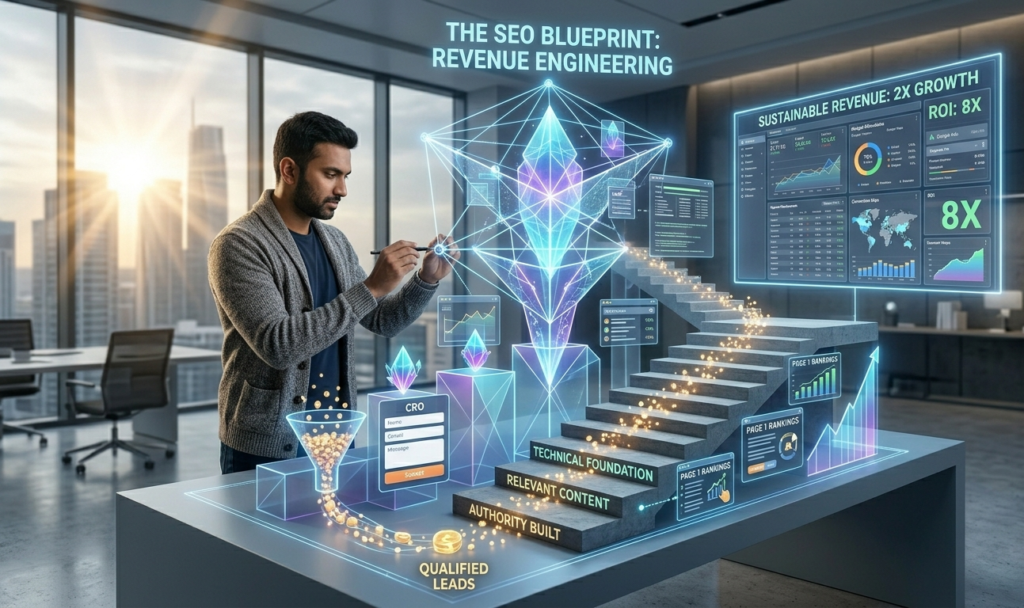
At Rachna Digital Hub, we don’t just “do SEO.” We treat your search visibility as the foundation and frame of your revenue engine. In 2026, the marketplace is too complex for a casual approach. You need a structural engineer for your digital presence.

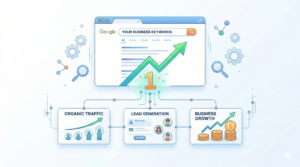
This is the SEO Blueprint. Let’s look at the three critical pillars you need to build to turn scattered searches into tangible revenue.


1. The Foundation: Deep Data and Structural Analysis

Before you lay a single brick of content or build a towering backlink profile, you must understand the ground you are building on. This is where most businesses fail. They start creating useful content before analyzing the landscape. The first phase of the SEO blueprint is strict Market Research and Technical Analysis.

What are you building toward?

  • User Intent Analysis: Don’t just find high-volume keywords. Ask why people search for them. Is the user looking to buy now (high-intent), or are they just looking for information (low-intent)? Your content must be structurally matched to this intent.

  • Structural Content Audit: We analyze the “cracks” in your current structure. Are your core pages too weak to support a towering ranking? Are there structural technical errors (e.g., slow load speed, non-mobile responsiveness) that are preventing Google’s bots from analyzing your site?

A technical foundation built on data ensures that your rankings don’t collapse when Google launches a new core algorithm update.


2. The Rising Structure: The Funnel of Strategic Content

Once the ground is analyzed and the foundation is secure, the structural framing begins. This is the stage where we build the visible elements that attract and funnel traffic. We do this with a Strategic Content Funnel, turning abstract concepts into predictable user pathways.

In 2026, search engines are smart enough to look past keywords; they analyze topical authority and user value.

We don’t just “post content.” We build a structure.

  • The Powerplay Inputs: Your highest-volume, general intent keywords are your inputs. They provide the necessary visibility and traffic volume to get noticed.

  • The Optimization Filters: These inputs must be refined. Through rigorous A/B testing, precise meta-tagging (titles, H1s, descriptions), and structural Keyword Placement, we filter the general traffic into highly qualified segments. This is where we apply the critical “data filters” from your technical analysis.

  • The Conversion Funnel: This strategic funnel doesn’t let traffic dissipate. It provides a logical flow, using precise internal linking, compelling Call-to-Actions (CTAs), and Conversion Rate Optimization (CRO) principles to drive traffic toward a single, glowing objective: Qualified Leads.

This structural framing is consistent, tactical, and built for Return on Investment (ROI). It is a predictable machine designed for growth.


3. The Pinnacle: Real-Time Performance and Sustainable Revenue

The structure is complete, the funnel is flowing, but the work is not over. In a dynamic market, a structure that isn’t actively maintained will eventually degrade. The final stage of the SEO Blueprint is constant Performance Tracking and Iterative Improvement.

You need a real-time dashboard that connects ranking data to revenue metrics. We don’t measure success by a “Page 1 Ranking.” We measure success by your funnel efficiency.

  • Real-Time ROI: We use advanced tracking (like Google Analytics 4 and custom dashboards) to connect organic search traffic directly to lead conversions and, ultimately, sustainable revenue. When we “hit enter” on an optimization, we see the immediate impact on your bottom line.

  • A/B Testing and Strategic Interventions: When we see that a specific funnel path is underperforming (e.g., a low click-through rate or high bounce rate on a key landing page), we don’t guess. We perform a data intervention. We might re-write the meta description, re-structure the CTA placement, or perform a different Strategic Pivot.

This is not a project; it is a permanent structural operation that turns data into continuous improvement. We turn scattered organic search data into a polished revenue trophy.

Schedule Your Structural Audit

Just as you wouldn’t build a skyscraper without a blueprint, you cannot build a sustainable revenue engine in digital marketing without a master plan. The SEO Blueprint is that plan.

Don’t let your digital presence be a fragile tent. Build a towering structure of revenue that dominates your industry. At Rachna Digital Hub, we are structural engineers for your search growth.

Contact us today to schedule your free competitor audit and structural consultation, and let’s start turning your rankings into sustainable revenue.

The SEO Blueprint: Turning Google Rankings into Sustainable Revenue Read More »

Generate Leads Online

How to Generate Leads Online for Your Business

How to Generate Leads Online for Your Business

Generating leads online is one of the most important goals for any business that wants to grow in today’s digital world. Whether you run a small startup or an established company, online lead generation helps you connect with potential customers, build relationships, and increase sales. With the right digital marketing strategies, businesses can attract targeted audiences and convert them into loyal clients.

In this blog, we will explore simple and effective ways to generate leads online for your business. These strategies are easy to implement, SEO-friendly, and suitable for businesses of all sizes.

1. Build a Professional and User-Friendly Website

Your website is the foundation of your online presence. It acts as your digital storefront where potential customers learn about your services. A well-designed website builds trust and encourages visitors to take action.

Make sure your website includes: generate leads online

Adding lead capture forms on your homepage and service pages helps collect visitor information. Keep the form simple by asking only necessary details like name, email, and phone number.

2. Use Search Engine Optimization (SEO)

SEO is one of the most powerful ways to generate organic leads. When your website ranks higher on search engines, more people can find your business. Generate Leads Online

To improve SEO:

  • Use relevant keywords in your content
  • Optimize meta titles and descriptions
  • Write informative blog posts
  • Add internal linking
  • Improve website speed

Creating blogs regularly increases your chances of ranking for different keywords. For example, writing about digital marketing tips, business growth strategies, and online advertising can attract targeted traffic.

3. Create High-Quality Content

Content marketing plays a key role in attracting potential customers. Informative and valuable content builds authority and trust. When people find helpful information, they are more likely to contact your business.

You can create:Generate leads online

  • Blog posts
  • Guides
  • Infographics
  • Case studies
  • Checklists

Focus on solving your audience’s problems. For example, if you offer digital marketing services, write content about increasing website traffic, social media growth, and lead generation techniques.

4. Leverage Social Media Marketing

Social media platforms help businesses connect directly with their audience. Posting regularly keeps your brand visible and encourages engagement. generate leads online

Tips for social media lead generation:

  • Share informative posts
  • Use engaging captions
  • Add call-to-action like Contact us
  • Post customer testimonials
  • Share blog links

Platforms like Facebook, Instagram, and LinkedIn are excellent for generating leads. Consistency is important, so create a posting schedule to stay active.

5. Run Paid Advertising Campaigns

Paid advertising is a fast way to generate leads. Platforms like Google Ads and social media ads allow you to target specific audiences based on location, interests, and behavior.

Benefits of paid ads:

  • Instant traffic
  • Targeted audience
  • Higher conversions
  • Budget control

Create attractive ad copies with clear call-to-actions. Direct users to a landing page designed specifically for lead capture.

6. Offer Free Value to Attract Leads

Providing something valuable for free encourages visitors to share their contact information. This strategy is known as a lead magnet.

Examples of lead magnets:

  • Free consultation
  • Free audit
  • E-book
  • Checklist
  • Discount offer

Make sure your offer is relevant to your services. For example, a digital marketing agency can offer a free website analysis or SEO audit.

7. Use Email Marketing

Email marketing helps nurture potential leads and convert them into customers. Once you collect email addresses, you can send updates, offers, and valuable content.

Effective email marketing tips:

  • Send welcome emails
  • Share useful tips
  • Promote services
  • Offer discounts
  • Keep emails short and clear

Consistency is key. Sending regular emails keeps your brand in the customer’s mind.

8. Optimize Landing Pages

Landing pages are designed specifically to convert visitors into leads. A strong landing page includes:

  • Clear headline
  • Benefits of your service
  • Testimonials
  • Contact form
  • Call-to-action button

Avoid distractions and focus on one goal. The simpler the page, the better the conversion rate.

9. Use Call-to-Action (CTA) Effectively

Call-to-action buttons guide users to take the next step. Without CTAs, visitors may leave without contacting you.

Examples of strong CTAs:

  • Get Free Consultation
  • Contact Us Today
  • Request a Quote
  • Start Now
  • Book Your Service

Place CTAs on:

  • Homepage
  • Blog posts
  • Service pages
  • Footer section

10. Collect and Display Testimonials

Customer reviews build trust and credibility. When potential clients see positive feedback, they are more likely to choose your business.

You can add testimonials:

  • On homepage
  • On service pages
  • In social media posts
  • On landing pages

Authentic reviews increase conversions and generate more leads.

11. Use Local SEO for Targeted Leads

If you provide services in specific locations, local SEO helps attract nearby customers. Optimize your website with location-based keywords.

Examples:

  • Digital marketing services in your city
  • SEO services near me
  • Online marketing agency in your area

Create location-specific pages to improve visibility in local search results.

12. Track and Improve Your Strategy

Lead generation is an ongoing process. Track your performance to see what works best.

Monitor:

  • Website traffic
  • Conversion rate
  • Click-through rate
  • Engagement rate

Based on data, improve your content, ads, and landing pages to increase leads.

Conclusion

Generating leads online is essential for business growth. By using strategies like SEO, content marketing, social media, paid ads, and email marketing, businesses can attract targeted audiences and convert them into customers. The key is consistency, quality content, and clear call-to-actions.

Start implementing these lead generation techniques today and watch your business grow online. With the right digital marketing approach, you can increase traffic, build trust, and generate high-quality leads that drive long-term success.

How to Generate Leads Online for Your Business Read More »

digital marketing during crisis

Global Crisis & Local Businesses: Role of Digital Marketing Agencies.

Why Businesses Need Digital Marketing Agencies in Uncertain Times

Digital marketing during crisis such as economic instability, supply chain disruption, fuel shortages, or lockdown fears can quickly affect local businesses. When customers reduce spending and physical visits drop, companies must find new ways to stay visible and continue selling. This is where digital marketing agencies play a crucial role. They help businesses shift from traditional methods to online platforms, ensuring they remain connected with customers. In difficult times, companies that invest in online marketing often recover faster because they maintain communication, build trust, and generate leads.

Today, consumers search online before making decisions. Whether they are looking for services, products, or updates, the internet becomes the first place they go. Digital marketing agencies understand how to position businesses in front of these online audiences. They create strategies that increase visibility, improve engagement, and drive conversions. During uncertain periods, this support becomes even more important because competition increases and customers become more selective.


How Global Crisis Impacts Local Businesses

When a crisis occurs, local businesses face several challenges. Customer footfall drops, operational costs increase, and uncertainty affects buying behavior. Many companies reduce marketing budgets, but this can lead to lower visibility. Instead of stopping marketing, businesses should adapt. Digital marketing agencies help brands maintain their presence without high costs. They focus on targeted campaigns, social media communication, and search engine visibility.

Local businesses often depend on nearby customers. During a crisis, people may prefer online shopping or remote services. This shift creates opportunities. With the right guidance, digital marketing agencies help companies reach customers digitally, even when physical operations slow down. They ensure that businesses stay active, visible, and competitive.


Major Role of Digital Marketing Agencies During Crisis

1. Building Strong Online Presence

A strong online presence is essential when offline visibility decreases. Websites, social media pages, and online listings become the new storefronts. Digital marketing agencies optimize websites, improve search rankings, and manage social media platforms. This helps businesses appear in search results when customers look for services.

By using SEO strategies, digital marketing agencies increase organic traffic. They also update business information, post relevant content, and maintain customer engagement. These actions keep brands active and trustworthy. A well-managed online presence ensures that customers can easily find businesses during uncertain times.

2. Cost-Effective Marketing Solutions

During a crisis, businesses need affordable marketing options. Traditional advertising can be expensive and less effective. Digital marketing agencies offer budget-friendly strategies such as social media marketing, email campaigns, and local SEO. These methods deliver better results at lower costs.

Targeted advertising is another advantage. Instead of reaching everyone, digital marketing agencies focus on specific audiences. This improves conversion rates and reduces wasted spending. Companies can track performance and adjust campaigns based on real-time data. This flexibility is valuable during unpredictable situations.

3. Strengthening Customer Communication

Communication becomes critical during uncertain times. Customers want updates about services, delivery options, and availability. Digital marketing agencies help businesses communicate clearly through social media posts, emails, and website updates. Transparent communication builds trust and loyalty.

Regular engagement keeps customers informed and connected. Digital marketing agencies create meaningful content that addresses customer concerns. They respond to queries, manage reviews, and encourage interaction. This continuous communication helps businesses maintain relationships even during difficult periods.

4. Increasing Local Visibility

Local businesses rely on nearby customers. When foot traffic decreases, online local searches increase. Digital marketing agencies optimize Google Business profiles, improve local SEO, and encourage customer reviews. These efforts help businesses appear in local search results.

By targeting location-based keywords, digital marketing agencies ensure that businesses reach customers in their area. This strategy increases calls, inquiries, and online orders. Local visibility is especially important when customers prefer nearby services.

5. Adapting to Changing Consumer Behavior

Consumer behavior changes during crises. People may spend less, compare more, and look for value. Digital marketing agencies analyze trends and adjust strategies accordingly. They focus on customer needs, create relevant campaigns, and highlight solutions.

For example, digital marketing agencies may promote online consultations, delivery services, or special offers. These adjustments help businesses remain relevant. Understanding customer behavior ensures that marketing efforts match current demand.

6. Generating Leads and Sales

Even during difficult times, businesses need leads and sales. Digital marketing agencies design campaigns that attract potential customers. They use SEO, paid ads, and social media to generate inquiries. Lead generation forms, landing pages, and call-to-action strategies increase conversions.

By tracking performance, digital marketing agencies identify what works best. They refine campaigns and improve results. This data-driven approach helps businesses maintain revenue during challenging periods.

7. Building Long-Term Brand Trust

Trust is essential during uncertain times. Customers prefer brands that communicate clearly and provide value. Digital marketing agencies help businesses build credibility through content marketing, reviews, and consistent messaging. Educational blogs, helpful posts, and informative videos create authority.

Over time, digital marketing agencies strengthen brand identity. When the crisis ends, businesses with strong trust recover faster. Long-term brand building ensures sustainable growth.


Why Businesses Must Invest in Digital Marketing Agencies

Investing in digital marketing agencies is not just a short-term solution. It is a long-term strategy for growth and stability. Businesses that rely only on offline marketing risk losing visibility. Online presence ensures continuity even during disruptions.

Professional expertise is another advantage. Digital marketing agencies understand market trends, tools, and platforms. They create customized strategies based on business goals. This saves time and delivers better results. Companies can focus on operations while experts handle marketing.

Additionally, digital marketing agencies provide measurable results. Businesses can track traffic, engagement, and conversions. This transparency helps in decision-making. Data-driven strategies reduce risks and improve efficiency.


Conclusion

Global crises create uncertainty, but they also highlight the importance of adaptability. Local businesses must stay visible, communicate effectively, and reach customers online. Digital marketing agencies provide the expertise and tools needed to achieve these goals. They help businesses build online presence, manage communication, and generate leads even during difficult times.


Global Crisis & Local Businesses: Role of Digital Marketing Agencies. Read More »

Scroll to Top
Rachna Digital Hub