
Content Writing

ChatGPT vs Claude AI for Digital Marketing

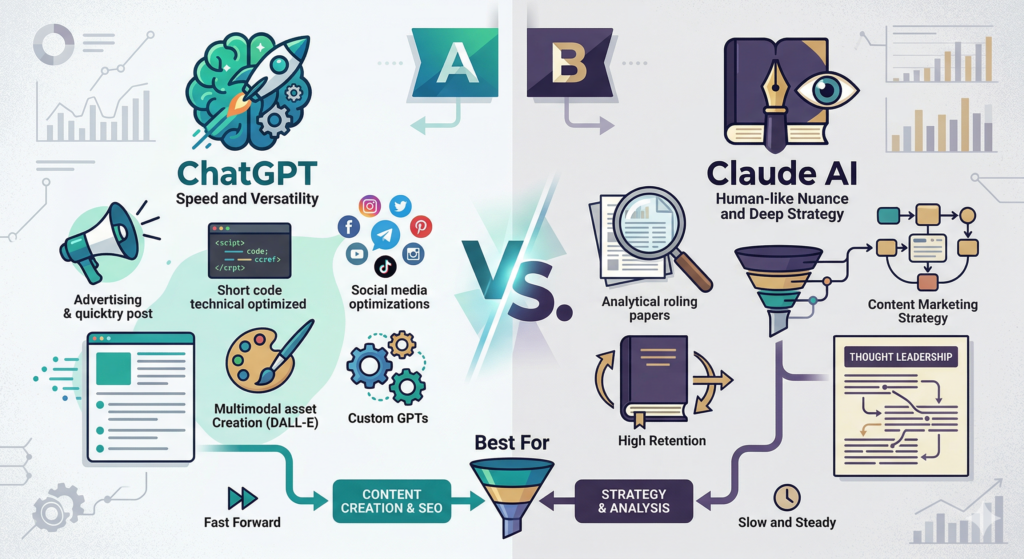
ChatGPT vs Claude AI for Digital Marketing: Which One Should You Use?

ChatGPT vs Claude AI for Digital Marketing: Which One Should You Use?

Artificial intelligence is transforming digital marketing, helping professionals create content, optimize SEO strategies, analyze data, and automate workflows. Two of the most popular AI tools today are ChatGPT and Claude. Both offer powerful features, but they work differently when applied to digital marketing tasks.

If you’re a marketer, blogger, or business owner, understanding the differences between ChatGPT and Claude AI can help you choose the right tool for your needs.

What is ChatGPT?

ChatGPT is an AI-powered conversational assistant designed to generate text, ideas, and solutions quickly. It is widely used in digital marketing for content creation, SEO optimization, keyword research, and social media planning.

ChatGPT Strengths for Digital Marketing

  • Fast content generation
  • SEO-friendly blog writing
  • Keyword research assistance
  • Social media caption creation
  • Ad copy generation
  • Email marketing content
  • Structured outlines and lists

ChatGPT is ideal for marketers who need quick, actionable outputs and structured content.

What is Claude AI?

Claude AI is another advanced AI assistant focused on detailed, thoughtful, and contextual responses. It is particularly useful for long-form content, strategy planning, and research-heavy marketing tasks.

Claude AI Strengths for Digital Marketing

  • Long-form content creation
  • In-depth marketing strategy
  • Detailed analysis
  • Brand voice development
  • Research-based writing
  • Content editing and refinement
  • Complex topic explanation

Claude AI is best suited for marketers who want comprehensive and contextual responses.

Content Writing Comparison

Content is one of the biggest areas where digital marketers use AI tools.

ChatGPT for Content Writing

ChatGPT excels at:

  • Blog outlines
  • Short articles
  • SEO-friendly content
  • Product descriptions
  • Landing page copy
  • Social media content

It usually provides structured responses with headings and bullet points, making it easy to publish quickly.

Claude AI for Content Writing

Claude AI is better for

  • Long-form blogs
  • In-depth guides
  • Thought leadership content
  • Analytical posts
  • Story-based marketing

It tends to generate more detailed explanations and more profound insights.

SEO and Keyword Research

Both tools support SEO, but their approach differs.

ChatGPT for SEO

ChatGPT works well for:

  • Generating keyword lists
  • Creating meta descriptions
  • Writing SEO-friendly blogs
  • Generating FAQ sections
  • On-page SEO suggestions

It is efficient for quick SEO tasks and optimization.

Claude AI for SEO

Claude AI performs better for

  • Topic clustering
  • Content strategy planning
  • Search intent analysis
  • Long-tail keyword variations
  • Comprehensive SEO content

It focuses more on strategy than speed.

Social Media Marketing

Social media content creation is another key area.

ChatGPT for Social Media

ChatGPT helps with:

  • Instagram captions
  • Facebook posts
  • LinkedIn content
  • Hashtag suggestions
  • Short promotional text

It is excellent for quick daily posting.

Claude AI for Social Media

Claude AI helps with:

  • Content calendar planning
  • Brand voice consistency
  • Long captions
  • Audience-focused messaging
  • Campaign storytelling

It is useful for planned marketing campaigns.

Google Ads and Ad Copy

AI tools are also useful for paid advertising.

ChatGPT for Ads

ChatGPT can generate:

  • Google Ads headlines
  • Meta Ads copy
  • Call-to-action phrases
  • A/B testing variations

It works well for quick ad creation.

Claude AI for Ads

Claude AI helps with:

  • Ad strategy planning
  • Audience targeting ideas
  • Funnel-based messaging
  • Detailed campaign structure

It focuses more on advertising strategy.

Blogging and Website Content

For bloggers and website owners, choosing the right AI matters.

ChatGPT is better for:

  • Quick blog posts
  • SEO-optimized articles
  • Topic ideas
  • Internal linking suggestions

Claude AI is better for

  • Pillar content
  • Evergreen guides
  • In-depth tutorials
  • Content expansion

Using both together can create a powerful blogging strategy.

Ease of Use

ChatGPT is:

  • Faster
  • More structured
  • Beginner-friendly
  • Ideal for quick tasks

Claude AI is

  • More detailed
  • Context-focused
  • Better for advanced users
  • Ideal for research

Which One is Better for Digital Marketing?

The answer depends on your goals.

Choose ChatGPT if you want:

  • Fast content creation
  • SEO blog writing
  • Social media posts
  • Quick marketing ideas
  • Ad copy generation

Choose Claude AI if you want:

  • Detailed marketing strategy
  • Long-form content
  • Research-based articles
  • Brand voice development
  • Content planning

Best Strategy: Use Both Together

Many digital marketers combine both tools:

  • Use ChatGPT for quick drafts
  • Use Claude AI for expanding content
  • Use ChatGPT for SEO keywords
  • Use Claude AI for content depth
  • Use ChatGPT for social posts
  • Use Claude AI for campaign strategy

This combination improves productivity and content quality.

Conclusion

Both ChatGPT and Claude AI are powerful tools for digital marketing. ChatGPT is ideal for speed, structure, and SEO-friendly content, while Claude AI excels in depth, strategy, and long-form writing. The best approach is to understand your marketing needs and use the tool that fits your workflow. For maximum results, combining both can help you create high-quality content, improve SEO, and build a strong digital presence.

ChatGPT vs Claude AI for Digital Marketing: Which One Should You Use? Read More »
How To Write Digital Marketing Content:

How To Write Digital Marketing Content: Engages, Converts, and Builds Brand Authority.

How To Write Digital Marketing Content That Engages, Converts, and Builds Brand Authority.

We all know content writing must be effective for marketing. Content is more than just putting words on a page—it’s about delivering the right message to the right audience at the right time. Good marketing content informs, engages, and persuades readers to take action. Whether it’s a blog, website copy, or social media post, the goal is to connect with your audience and guide them toward a decision. By understanding your audience, using clear strategies, and focusing on value, you can create content that not only attracts attention but also drives meaningful results.

A Step-by-Step Guide to Creating Content That Attracts the Right Audience and Drives Results.

In this time, where competition is seen in the digital world, content plays a crucial role in the success of any marketing strategy. Businesses rely on content to communicate their message, promote their products, and build relationships with customers. However, not all content is effective. Poorly written or irrelevant content can fail to capture attention and may even harm a brand’s reputation.

Writing marketing content requires a combination of creativity, strategy, and understanding of your audience. It involves crafting messages that resonate with readers while aligning with business goals. From choosing the right words to structuring your content effectively, every element plays a role in its success. This guide will help you understand how to write marketing content that stands out and delivers results.


1. Understand Your Target Audience:

The first step in writing effective marketing content is understanding who you are writing for. Knowing your audience helps you tailor your message to their needs, preferences, and interests.

Start by identifying your target audience’s demographics, such as age, location, and profession. Then, focus on their challenges, goals, and pain points. What problems are they trying to solve? What information are they looking for?  How To Write Marketing Content That Engages, Converts, and Builds Brand Authority. Writing effective marketing content is more than just putting words on a page

When you understand your audience, you can create content that speaks directly to them. This increases engagement and makes your content more relevant and impactful.


2. Define Your Purpose and Goals:

Every piece of marketing content should have a clear purpose. Are you trying to inform, educate, promote, or persuade? Defining your goal helps you stay focused and ensures your content delivers the desired outcome.

For example, a blog post may aim to educate readers, while a product page focuses on conversions. Setting clear objectives allows you to measure the success of your content and make improvements where needed.


3. Create Compelling Headlines

Your headline is the first thing readers see, and it determines whether they will continue reading. A strong headline grabs attention and clearly communicates the value of your content.

Use simple and powerful language, and focus on benefits rather than features. Headlines that address a problem or promise a solution tend to perform well.

For example, instead of writing Marketing Tips you could write “10 Proven Marketing Tips to Boost Your Sales. This makes the content more appealing and relevant.


4. Focus on Value and Relevance

Effective marketing content provides value to the reader. It should answer questions, solve problems, or offer useful insights.

Avoid creating content that is overly promotional or sales-focused. Instead, focus on delivering helpful and informative content that builds trust with your audience.

When readers find value in your content, they are more likely to engage with your brand and take action.


5. Use Clear and Simple Language

Clarity is key in marketing content writing. Avoid using complex words or jargon that may confuse your audience.

Write in a conversational tone that is easy to understand. Use short sentences and paragraphs to improve readability. This ensures that your message is clear and accessible to a wider audience.

Remember, the goal is to communicate effectively, not to impress with complicated language.


6. Incorporate SEO Best Practices

Search Engine Optimization (SEO) is essential for making your content visible online. By optimizing your content for search engines, you can attract more organic traffic.

Use relevant keywords naturally throughout your content, including in the headline, subheadings, and body text. However, avoid keyword stuffing, as it can negatively impact readability and rankings.

Additionally, use proper formatting, such as headings and bullet points, to make your content easier to scan. This improves both user experience and SEO performance.


7. Add Strong Calls-to-Action (CTAs)

A call-to-action (CTA) encourages readers to take the next step, whether it’s signing up for a newsletter, downloading a resource, or making a purchase.

Make your CTAs clear, concise, and action-oriented. Use phrases like “Learn more,” “Get started,” or “Contact us today.”

Strategically placing CTAs within your content helps guide readers through the conversion process and increases the effectiveness of your marketing efforts.


8. Use Storytelling Techniques

Storytelling is a powerful tool in marketing content writing. It helps create an emotional connection with your audience and makes your content more engaging.

Share real-life examples, case studies, or personal experiences to illustrate your points. Stories make your content relatable and memorable, increasing its impact.

By incorporating storytelling, you can turn ordinary content into compelling narratives that resonate with readers.


9. Edit and Optimize Your Content

Writing is only the first step; editing is equally important. Review your content for grammar, spelling, and clarity. Ensure that your message is consistent and aligned with your goals.

Additionally, analyze your content’s performance using analytics tools. Identify what works and what doesn’t, and make improvements accordingly.

Continuous optimization helps you refine your content strategy and achieve better results over time.


10. Maintain Consistency and Quality

Consistency is essential for building a strong brand presence. Regularly publishing high-quality content keeps your audience engaged and reinforces your brand message.

Create a content calendar to plan and organize your content. This ensures that you maintain a consistent posting schedule and cover a variety of topics.

Quality should always be a priority. Well-researched and well-written content reflects professionalism and builds trust with your audience.


Conclusion: Turning Words Into Results

Writing effective marketing content is both an art and a science. It requires a deep understanding of your audience, clear goals, and a strategic approach to communication. By focusing on value, clarity, and engagement, you can create content that not only attracts attention but also drives meaningful results.


How To Write Digital Marketing Content: Engages, Converts, and Builds Brand Authority. Read More »

Content Writing & Blogging: The Base Of Successful Digital Marketing.

Content Writing & Blogging: The Base Of Successful Digital Marketing.

In the modern era of technology, companies must build trust before they can sell. Consumers research, compare, and assess brands online prior to making a decision. Blogging and content production are useful in this situation. High-quality content promotes credibility and long-lasting client relationships in addition to offering knowledge and instruction. Content Writing & Blogging

Content writing and blogging are not just about writing articles. They are strategic tools that help businesses attract traffic, improve search engine rankings, and convert visitors into loyal customers.

What Is Content Writing?

Content writing is the process of creating valuable, relevant, and engaging content for websites, blogs, social media, emails, and other digital platforms. The goal is to provide useful information while guiding readers toward a specific action.

Effective content writing focuses on:

  • Understanding the target audience

  • Solving real problems

  • Using clear and simple language

  • Including relevant keywords

  • Encouraging engagement

Good content does not feel like advertising. Instead, it builds trust and authority naturally.

What Is Blogging?

Blogging is a long-term content marketing strategy where businesses regularly publish informative articles on their website. Blogging helps answer common customer questions, provide industry insights, and improve online visibility.

Search engines like Google prioritize websites that regularly publish high-quality and relevant content. This means consistent blogging can significantly improve your search rankings.

1. Improves Search Engine Rankings

Search Engine Optimization (SEO) and content go hand in hand. Every blog post gives you the opportunity to target new keywords. When optimized properly, blogs help your website rank higher in search results.

More rankings mean:

  • More organic traffic

  • More brand visibility

  • More potential leads

Without content, SEO cannot work effectively.

2. Builds Authority and Trust

Customers trust businesses that provide helpful information. When you consistently share valuable insights, people see you as an expert in your industry.

For example, if you run a digital marketing agency and regularly publish blogs about SEO, paid ads, and social media strategies, potential clients will view you as knowledgeable and reliable.

Trust leads to conversions.

3. Generates Long-Term Traffic

Paid advertising gives instant traffic, but blogging provides long-term benefits. A well-written blog post can generate traffic for months or even years.

Unlike ads that stop when the budget ends, organic content continues to work for your business without additional cost.

4. Supports Social Media Marketing

Content created for blogs can be repurposed into social media posts on platforms like Facebook and LinkedIn.

One blog can become:

  • Multiple social media posts

  • Short tips and quotes

  • Infographics

  • Email newsletters

This maximizes your marketing efforts.

5. Improves Conversion Rates

Good content guides readers through the buyer journey. Informative blogs answer questions, remove doubts, and encourage action.

When combined with clear calls-to-action such as “Contact Us”, “Get a Free Consultation”, or “Download Now”, content becomes a powerful lead-generation tool.

Key Elements of Effective Content Writing

To achieve strong results, content must include the following:

Clear Structure

A blog should have:

  • A strong headline

  • An engaging introduction

  • Organized subheadings

  • Short paragraphs

  • A compelling conclusion

This improves readability and keeps readers engaged.

Audience-Focused Writing

Understanding your audience is essential. Ask yourself:

  • What problems are they facing?

  • What information are they searching for?

  • What solutions can you offer?

Write content that directly addresses their needs.

SEO Optimization

Effective blogging includes:

  • Relevant keywords

  • Meta titles and descriptions

  • Internal linking

  • Proper formatting

SEO-friendly content increases discoverability.

Consistency

Publishing one blog is not enough. Consistency builds momentum. Businesses that publish blogs regularly see better engagement and stronger search performance.

Types of Blog Content Businesses Can Create

To keep content fresh and engaging, businesses can publish:

  • How-to guides

  • Industry trends

  • Case studies

  • List-based articles

  • Frequently asked questions

  • Expert opinions

  • Beginner guides

Variety keeps your audience interested and encourages repeat visits.

Common Mistakes to Avoid

Many businesses make mistakes that reduce content effectiveness:

  • Writing only promotional content

  • Ignoring keyword research

  • Publishing inconsistent blogs

  • Using complicated language

  • Not including calls-to-action

Content should educate first and sell later.

Content Writing for Small Businesses

Small businesses often think blogging is only for large companies. However, blogging is one of the most affordable and powerful marketing tools for small brands.

Local businesses can use content to:

  • Target location-based keywords

  • Educate customers about services

  • Share success stories

  • Improve local SEO

With the right strategy, even small businesses can compete with larger brands online.

Final Thoughts

Content writing and blogging are the foundation of digital marketing success. They help businesses build trust, improve search engine rankings, attract organic traffic, and generate leads consistently.

Content Writing & Blogging: The Base Of Successful Digital Marketing. Read More »

Scroll to Top
Rachna Digital Hub