Digital Marketing

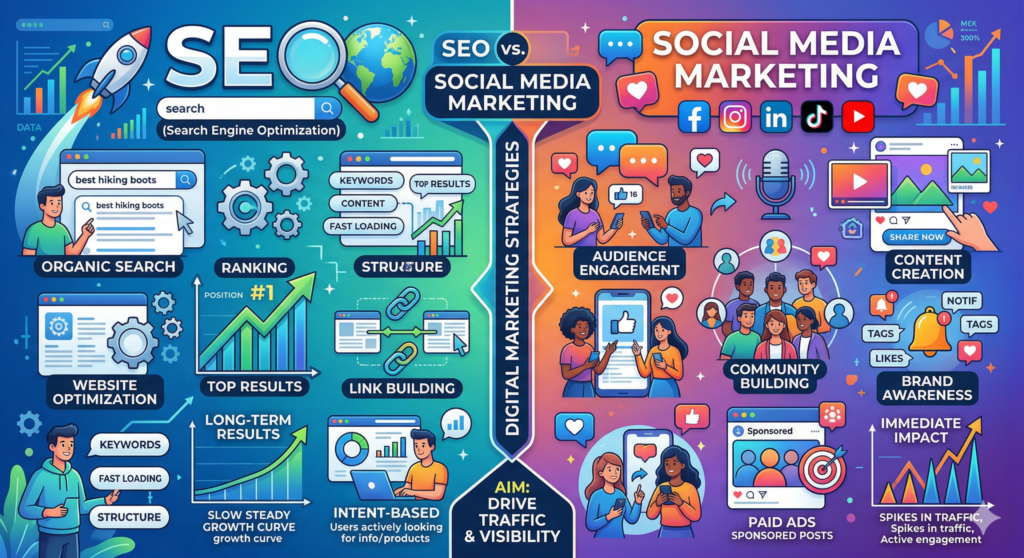
SEO vs Social Media Marketing

SEO vs Social Media Marketing

SEO vs Social Media Marketing – Which is Better for Beginners?

Digital marketing offers many ways to promote a business online, but two of the most popular methods are SEO and Social Media Marketing. Beginners often get confused about which one is better and where they should start. Both strategies help increase website traffic, brand awareness, and leads, but they work differently. In this guide, we will compare SEO vs Social Media Marketing in simple terms so beginners can choose the best option.

What is SEO?

SEO stands for Search Engine Optimization. It is the process of optimizing your website so it ranks higher on search engines like Google. When people search for keywords related to your business, your website appears in search results.
For example, if someone searches digital marketing services, SEO helps your website show on the first page. The main goal of SEO is to get organic traffic without paying for ads.

Key Elements of SEO

  • Keyword research
  • On-page optimization
  • Technical SEO
  • Content creation
  • Backlink building
  • Website speed optimization

SEO is a long-term strategy that builds trust and authority over time.

What is Social Media Marketing?
Social media marketing involves promoting your business on platforms like Facebook, Instagram, LinkedIn, and Twitter. It helps you connect directly with your audience and build brand awareness.

Businesses use social media to share posts, videos, stories, and promotions. Social media marketing can generate quick traffic and engagement.

Key Elements of Social Media Marketing

  • Creating social media profiles 
  • Posting engaging content
  • Using hashtags
  • Running ads
  • Interacting with followers
  • Sharing images and videos

Social media marketing focuses on engagement and brand visibility.

SEO vs Social Media Marketing: Major Differences

1. Traffic Source

SEO brings traffic from search engines. Users visit your website when they search for something. This traffic is highly targeted because users already have intent.

Social media marketing brings traffic from social platforms. People may not always be searching for your services, but they discover your brand through posts.

2. Time to See Results

SEO takes time. It may take weeks or months to rank your website. However, once your site ranks, it can bring consistent traffic.

Social media marketing gives faster results. A single viral post can bring instant traffic and engagement.

3. Cost

SEO mainly requires time and effort. You can do SEO without spending money, although tools may help.

Social media marketing can be free, but many businesses use paid ads to increase reach. Ads require a budget.

4. Long-Term Benefits

SEO offers long-term benefits. A well-optimized blog can generate traffic for years.

Social media posts have a short life. Engagement usually decreases after a few days.

5. Audience Engagement

SEO focuses more on search traffic. Interaction happens when users visit your website.

Social media marketing allows direct interaction. You can reply to comments, messages, and build relationships.

Advantages of SEO for Beginners
SEO is beneficial for beginners because:

  • It brings free organic traffic
  • Builds website authority
  • Helps long-term growth
  • Improves brand credibility
  • Generates high-quality leads

If your goal is to grow your website and get consistent traffic, SEO is a strong option.

Advantages of Social Media Marketing for Beginners

Social media marketing is also useful for beginners because:

  • Easy to start
  • No technical knowledge required
  • Quick visibility
  • Helps build brand awareness
  • Encourages direct communication

If you want quick engagement and brand visibility, social media marketing is helpful.

When Should Beginners Choose SEO?

Beginners should focus on SEO when:

  • They have a website or blog
  • They want long-term traffic
  • They want to rank on Google
  • They are willing to wait for results
  • They want organic leads

SEO is ideal for bloggers, service providers, and businesses with websites.

When Should Beginners Choose Social Media Marketing?

Beginners should focus on social media marketing when:

  • They want quick traffic
  • They don’t have a website yet
  • They want brand awareness
  • They want to interact with customers
  • They promote visual products

Social media marketing works well for small businesses, influencers, and startups.

Can You Use Both SEO and Social Media Marketing?

Yes, the best strategy is to use both. SEO and social media marketing work better together.

For example:

  • Write SEO-friendly blog posts
  • Share blog posts on social media
  • Drive traffic from social platforms
  • Increase engagement
  • Improve brand visibility

Using both strategies helps maximize online growth.

Which is Easier for Beginners?

Social media marketing is easier to start. You can create an account and start posting immediately.

SEO requires learning keywords, content writing, and optimization. However, once you learn SEO basics, it becomes easier.

Which Brings Better Results?

Both methods give good results, but it depends on your goal.

If your goal is long-term traffic, SEO is better.
If your goal is quick visibility, social media marketing is better.
If your goal is business growth, use both together.

Best Strategy for Beginners

Here is a simple strategy:

  • Start with social media marketing
  • Build audience and awareness
  • Create a website
  • Start SEO optimization
  • Share content on social media
  • Combine both methods

This approach gives both quick and long-term results.

Conclusion

SEO and Social Media Marketing are both powerful digital marketing strategies. SEO helps you get long-term organic traffic and build website authority, while social media marketing provides quick visibility and engagement. For beginners, social media marketing is easier to start, but SEO offers better long-term benefits.

The best approach is to combine both strategies. Use SEO to rank your website on search engines and social media marketing to promote your content and connect with your audience. By using both methods together, beginners can grow their online presence, increase traffic, and generate more leads effectively.

SEO vs Social Media Marketing Read More »
Winning the Digital Toss: Why SEO

Winning the Digital Toss: Why SEO is the Opening Partnership Your Business Needs

Winning the Digital Toss: Why SEO is the Opening Partnership Your Business Needs.

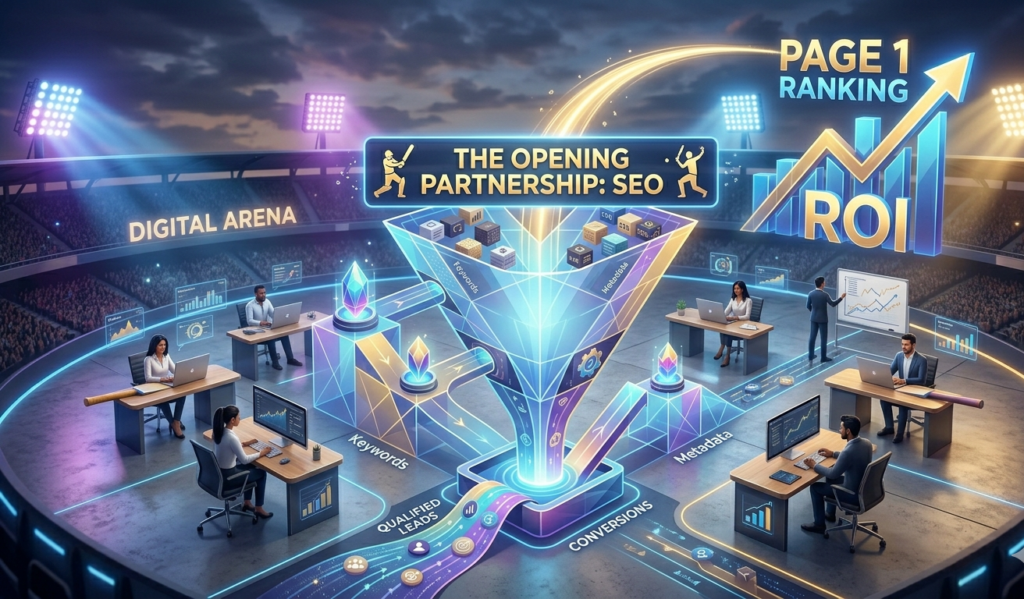
In the high-stakes world of the IPL, the “Opening Partnership” sets the tone for the entire innings. If your openers provide a solid start, the middle order can play with freedom, and the finishers can clear the boundary. But if you lose early wickets, you’re constantly playing catch-up.

Digital marketing is no different. Your business is the team, and the internet is the stadium. If you want to post a match-winning total (your revenue goals), you need a world-class opening partnership.

At Rachna Digital Hub, we believe SEO (Search Engine Optimization) is that vital opening pair. Winning the digital toss: why Search engine optimization? Because it provides the stability, the visibility, and the momentum your brand needs to dominate the marketplace. Here is the strategic blueprint for winning the digital toss and building an innings that lasts.


1. The Powerplay: Why Early Visibility is Non-Negotiable

In cricket, the Powerplay is the best time to score. With only two fielders outside the circle, every gap is an opportunity. In the digital world, the “Powerplay” happens every time a user types a query into Google. They are looking for an immediate solution, and if you aren’t in the top three results, you aren’t even on the field.

  • Winning the Toss: Having a technically sound website (fast loading, mobile-friendly, secure) is like winning the toss and choosing to bat on a flat track. It gives you the immediate advantage.

  • Exploiting the Gaps: Keyword research is the art of finding “gaps in the field.” We identify the specific terms your customers are using that your competitors have overlooked. By targeting these, you score “easy boundaries” (low-competition, high-intent traffic).

If you miss the Powerplay, you spend the rest of the game struggling to reach a competitive total. SEO ensures you start every “innings” with maximum momentum.


2. Building the Partnership: Content and Intent Alignment

A great opening partnership isn’t just about one person hitting sixes; it’s about two players understanding each other. In SEO, this partnership is between High-Quality Content and User Intent.

If your content doesn’t match what the user is actually looking for, you’ll get “run out.” Google’s sophisticated 2026 algorithms are like world-class umpires—they see everything. They can tell if a user is satisfied with your page or if they “bounced” back to the search results.

  • The Defensive Stroke (Technical SEO): Sometimes, you have to defend a good ball. Technical SEO—fixing broken links, optimizing image alt-text, and refining site architecture—protects your site from “wickets” (Google penalties or ranking drops).

  • The Aggressive Drive (Content Authority): To move the score along, you need authoritative content. We build “Topic Clusters” that demonstrate to Google that you aren’t just a one-hit-wonder, but a true expert in your field.

When your content perfectly aligns with what the user wants to find, the partnership becomes unbreakable. You build trust, session duration increases, and Google rewards you with even higher visibility.


3. The Death Overs: Turning Visibility into Victory (ROI)

You can have a great opening partnership, but if you don’t finish strong, you won’t win the match. In digital marketing, “finishing strong” means Conversion.

Organic leads are the most valuable players in your team. Why? Because they found you. They have already shown interest by searching for your services. Your job is to ensure the “Death Overs” (the final steps of the customer journey) are executed with clinical precision.

  • Closing the Gap: Once a lead lands on your site via an organic search, your Call to Action (CTA) must be as clear as a signal for a six. Whether it’s “Book a Consultation” or “Download our Guide,” the path to conversion must be frictionless.

  • Reviewing the DRS (Analytics): Just as teams use the Decision Review System, we use deep analytics to review every “play.” We track which keywords led to the most revenue—not just the most clicks. This allows us to refine your “batting order” and invest more in what works.

Sustainable revenue isn’t an accident; it’s the result of a perfectly executed opening partnership that transitions into a high-scoring finish.

Take the Field with Rachna Digital Hub

Don’t leave your business growth to chance. Don’t walk onto the digital field without a plan. You need an opening partnership that knows the pitch, understands the opposition, and has the technique to stay at the crease for the long haul.

At Rachna Digital Hub, we are the coaches and the opening partners you’ve been looking for. We specialize in building SEO strategies that don’t just “rank”—they win.

Winning the Digital Toss: Why SEO is the Opening Partnership Your Business Needs Read More »

The SEO Blueprint:

The SEO Blueprint: Turning Google Rankings into Sustainable Revenue

The SEO Blueprint: Turning Google Rankings into Sustainable Revenue

Ranking on page one of Google is a vanity metric. Running a multi-channel digital marketing campaign without a foundation is just noise. If you want to build sustainable, predictable revenue, you need more than a few scattered keywords. You need a complete structural plan.

At Rachna Digital Hub, we don’t just “do SEO.” We treat your search visibility as the foundation and frame of your revenue engine. In 2026, the marketplace is too complex for a casual approach. You need a structural engineer for your digital presence.

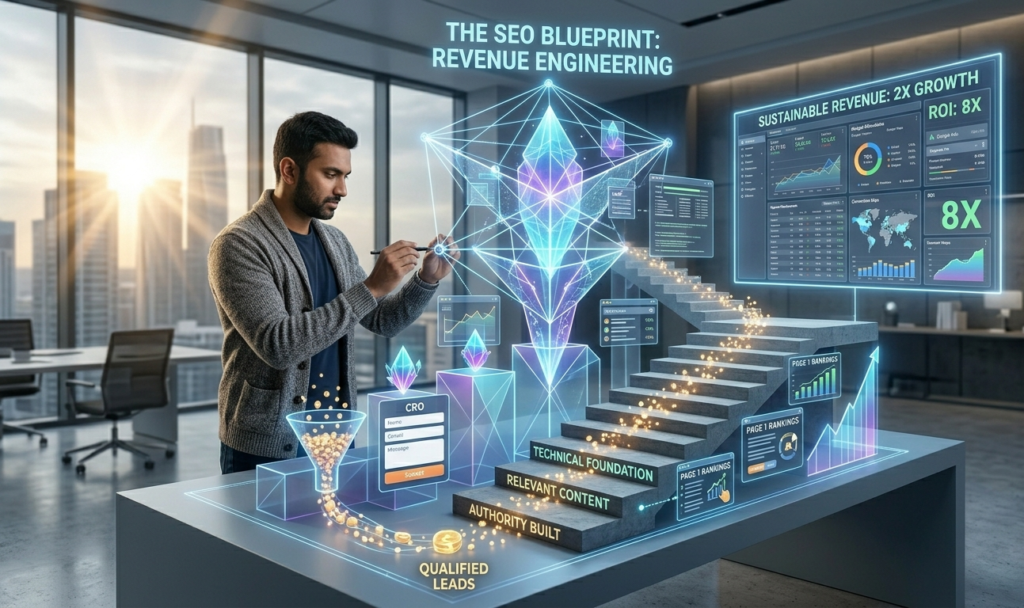
This is the SEO Blueprint. Let’s look at the three critical pillars you need to build to turn scattered searches into tangible revenue.


1. The Foundation: Deep Data and Structural Analysis

Before you lay a single brick of content or build a towering backlink profile, you must understand the ground you are building on. This is where most businesses fail. They start creating useful content before analyzing the landscape. The first phase of the SEO blueprint is strict Market Research and Technical Analysis.

What are you building toward?

  • User Intent Analysis: Don’t just find high-volume keywords. Ask why people search for them. Is the user looking to buy now (high-intent), or are they just looking for information (low-intent)? Your content must be structurally matched to this intent.

  • Structural Content Audit: We analyze the “cracks” in your current structure. Are your core pages too weak to support a towering ranking? Are there structural technical errors (e.g., slow load speed, non-mobile responsiveness) that are preventing Google’s bots from analyzing your site?

A technical foundation built on data ensures that your rankings don’t collapse when Google launches a new core algorithm update.


2. The Rising Structure: The Funnel of Strategic Content

Once the ground is analyzed and the foundation is secure, the structural framing begins. This is the stage where we build the visible elements that attract and funnel traffic. We do this with a Strategic Content Funnel, turning abstract concepts into predictable user pathways.

In 2026, search engines are smart enough to look past keywords; they analyze topical authority and user value.

We don’t just “post content.” We build a structure.

  • The Powerplay Inputs: Your highest-volume, general intent keywords are your inputs. They provide the necessary visibility and traffic volume to get noticed.

  • The Optimization Filters: These inputs must be refined. Through rigorous A/B testing, precise meta-tagging (titles, H1s, descriptions), and structural Keyword Placement, we filter the general traffic into highly qualified segments. This is where we apply the critical “data filters” from your technical analysis.

  • The Conversion Funnel: This strategic funnel doesn’t let traffic dissipate. It provides a logical flow, using precise internal linking, compelling Call-to-Actions (CTAs), and Conversion Rate Optimization (CRO) principles to drive traffic toward a single, glowing objective: Qualified Leads.

This structural framing is consistent, tactical, and built for Return on Investment (ROI). It is a predictable machine designed for growth.


3. The Pinnacle: Real-Time Performance and Sustainable Revenue

The structure is complete, the funnel is flowing, but the work is not over. In a dynamic market, a structure that isn’t actively maintained will eventually degrade. The final stage of the SEO Blueprint is constant Performance Tracking and Iterative Improvement.

You need a real-time dashboard that connects ranking data to revenue metrics. We don’t measure success by a “Page 1 Ranking.” We measure success by your funnel efficiency.

  • Real-Time ROI: We use advanced tracking (like Google Analytics 4 and custom dashboards) to connect organic search traffic directly to lead conversions and, ultimately, sustainable revenue. When we “hit enter” on an optimization, we see the immediate impact on your bottom line.

  • A/B Testing and Strategic Interventions: When we see that a specific funnel path is underperforming (e.g., a low click-through rate or high bounce rate on a key landing page), we don’t guess. We perform a data intervention. We might re-write the meta description, re-structure the CTA placement, or perform a different Strategic Pivot.

This is not a project; it is a permanent structural operation that turns data into continuous improvement. We turn scattered organic search data into a polished revenue trophy.

Schedule Your Structural Audit

Just as you wouldn’t build a skyscraper without a blueprint, you cannot build a sustainable revenue engine in digital marketing without a master plan. The SEO Blueprint is that plan.

Don’t let your digital presence be a fragile tent. Build a towering structure of revenue that dominates your industry. At Rachna Digital Hub, we are structural engineers for your search growth.

Contact us today to schedule your free competitor audit and structural consultation, and let’s start turning your rankings into sustainable revenue.

The SEO Blueprint: Turning Google Rankings into Sustainable Revenue Read More »

digital marketing during crisis

Global Crisis & Local Businesses: Role of Digital Marketing Agencies.

Why Businesses Need Digital Marketing Agencies in Uncertain Times

Digital marketing during crisis such as economic instability, supply chain disruption, fuel shortages, or lockdown fears can quickly affect local businesses. When customers reduce spending and physical visits drop, companies must find new ways to stay visible and continue selling. This is where digital marketing agencies play a crucial role. They help businesses shift from traditional methods to online platforms, ensuring they remain connected with customers. In difficult times, companies that invest in online marketing often recover faster because they maintain communication, build trust, and generate leads.

Today, consumers search online before making decisions. Whether they are looking for services, products, or updates, the internet becomes the first place they go. Digital marketing agencies understand how to position businesses in front of these online audiences. They create strategies that increase visibility, improve engagement, and drive conversions. During uncertain periods, this support becomes even more important because competition increases and customers become more selective.


How Global Crisis Impacts Local Businesses

When a crisis occurs, local businesses face several challenges. Customer footfall drops, operational costs increase, and uncertainty affects buying behavior. Many companies reduce marketing budgets, but this can lead to lower visibility. Instead of stopping marketing, businesses should adapt. Digital marketing agencies help brands maintain their presence without high costs. They focus on targeted campaigns, social media communication, and search engine visibility.

Local businesses often depend on nearby customers. During a crisis, people may prefer online shopping or remote services. This shift creates opportunities. With the right guidance, digital marketing agencies help companies reach customers digitally, even when physical operations slow down. They ensure that businesses stay active, visible, and competitive.


Major Role of Digital Marketing Agencies During Crisis

1. Building Strong Online Presence

A strong online presence is essential when offline visibility decreases. Websites, social media pages, and online listings become the new storefronts. Digital marketing agencies optimize websites, improve search rankings, and manage social media platforms. This helps businesses appear in search results when customers look for services.

By using SEO strategies, digital marketing agencies increase organic traffic. They also update business information, post relevant content, and maintain customer engagement. These actions keep brands active and trustworthy. A well-managed online presence ensures that customers can easily find businesses during uncertain times.

2. Cost-Effective Marketing Solutions

During a crisis, businesses need affordable marketing options. Traditional advertising can be expensive and less effective. Digital marketing agencies offer budget-friendly strategies such as social media marketing, email campaigns, and local SEO. These methods deliver better results at lower costs.

Targeted advertising is another advantage. Instead of reaching everyone, digital marketing agencies focus on specific audiences. This improves conversion rates and reduces wasted spending. Companies can track performance and adjust campaigns based on real-time data. This flexibility is valuable during unpredictable situations.

3. Strengthening Customer Communication

Communication becomes critical during uncertain times. Customers want updates about services, delivery options, and availability. Digital marketing agencies help businesses communicate clearly through social media posts, emails, and website updates. Transparent communication builds trust and loyalty.

Regular engagement keeps customers informed and connected. Digital marketing agencies create meaningful content that addresses customer concerns. They respond to queries, manage reviews, and encourage interaction. This continuous communication helps businesses maintain relationships even during difficult periods.

4. Increasing Local Visibility

Local businesses rely on nearby customers. When foot traffic decreases, online local searches increase. Digital marketing agencies optimize Google Business profiles, improve local SEO, and encourage customer reviews. These efforts help businesses appear in local search results.

By targeting location-based keywords, digital marketing agencies ensure that businesses reach customers in their area. This strategy increases calls, inquiries, and online orders. Local visibility is especially important when customers prefer nearby services.

5. Adapting to Changing Consumer Behavior

Consumer behavior changes during crises. People may spend less, compare more, and look for value. Digital marketing agencies analyze trends and adjust strategies accordingly. They focus on customer needs, create relevant campaigns, and highlight solutions.

For example, digital marketing agencies may promote online consultations, delivery services, or special offers. These adjustments help businesses remain relevant. Understanding customer behavior ensures that marketing efforts match current demand.

6. Generating Leads and Sales

Even during difficult times, businesses need leads and sales. Digital marketing agencies design campaigns that attract potential customers. They use SEO, paid ads, and social media to generate inquiries. Lead generation forms, landing pages, and call-to-action strategies increase conversions.

By tracking performance, digital marketing agencies identify what works best. They refine campaigns and improve results. This data-driven approach helps businesses maintain revenue during challenging periods.

7. Building Long-Term Brand Trust

Trust is essential during uncertain times. Customers prefer brands that communicate clearly and provide value. Digital marketing agencies help businesses build credibility through content marketing, reviews, and consistent messaging. Educational blogs, helpful posts, and informative videos create authority.

Over time, digital marketing agencies strengthen brand identity. When the crisis ends, businesses with strong trust recover faster. Long-term brand building ensures sustainable growth.


Why Businesses Must Invest in Digital Marketing Agencies

Investing in digital marketing agencies is not just a short-term solution. It is a long-term strategy for growth and stability. Businesses that rely only on offline marketing risk losing visibility. Online presence ensures continuity even during disruptions.

Professional expertise is another advantage. Digital marketing agencies understand market trends, tools, and platforms. They create customized strategies based on business goals. This saves time and delivers better results. Companies can focus on operations while experts handle marketing.

Additionally, digital marketing agencies provide measurable results. Businesses can track traffic, engagement, and conversions. This transparency helps in decision-making. Data-driven strategies reduce risks and improve efficiency.


Conclusion

Global crises create uncertainty, but they also highlight the importance of adaptability. Local businesses must stay visible, communicate effectively, and reach customers online. Digital marketing agencies provide the expertise and tools needed to achieve these goals. They help businesses build online presence, manage communication, and generate leads even during difficult times.


Global Crisis & Local Businesses: Role of Digital Marketing Agencies. Read More »

Content Marketing Builds Brand Value Through Powerful Storytelling

How Content Marketing Builds Brand Value Through Powerful Storytelling.

How Content Marketing Builds Brand Value Through Powerful Storytelling.

Content Marketing In Digital Marketing: Building Value Through Strategic Storytelling.

Content marketing is a powerful strategy within digital marketing that focuses on creating and distributing valuable, relevant, and consistent content to attract and retain a clearly defined audience. Instead of directly promoting products or services, it aims to educate, inform, and engage users. This approach helps businesses build trust, establish authority, and guide potential customers through the buying journey. In today’s competitive digital landscape, content marketing plays a crucial role in driving organic traffic, improving brand awareness, and supporting long-term growth.


How Content Marketing Drives Engagement, Trust, and Long-Term Business Growth

In the digital age, consumers are more informed and selective than ever before. Traditional advertising methods are no longer enough to capture attention and build lasting relationships. This is where content marketing comes into play. It focuses on delivering value to the audience through informative and engaging content such as blogs, videos, social media posts, infographics, and more.

Content marketing is not just about creating content; it is about creating the right content for the right audience at the right time. It aligns closely with other digital marketing strategies like SEO, social media marketing, and email marketing, making it an essential component of any successful online strategy. When executed effectively, content marketing can turn visitors into loyal customers and brand advocates.


1. Builds Brand Awareness and Authority

One of the primary benefits of content marketing is its ability to build brand awareness. By consistently publishing high-quality content, businesses can increase their visibility and reach a wider audience.

Moreover, valuable content helps establish authority in a specific industry. When businesses share insights, expertise, and solutions to common problems, they position themselves as trusted sources of information. This credibility encourages users to rely on the brand, ultimately leading to increased trust and customer loyalty.


2. Drives Organic Traffic Through SEO

Content marketing and search engine optimization (SEO) work hand in hand. High-quality, keyword-optimized content helps websites rank higher on search engine results pages.

When businesses create content that answers user queries and addresses their needs, search engines recognize its value and rank it accordingly. This leads to increased organic traffic, which is both cost-effective and highly targeted.

Blog posts, articles, and guides are particularly effective in attracting users who are actively searching for information, making content marketing a key driver of website traffic.


3. Engages and Educates the Audience

Content marketing allows businesses to engage with their audience on a deeper level. Instead of pushing sales messages, it focuses on providing useful and relevant information.

Educational content helps users understand products or services better, making them more confident in their purchasing decisions. Engaging formats such as videos, infographics, and interactive content further enhance user experience and keep audiences interested.

This engagement not only increases time spent on the website but also improves brand perception.


4. Supports Lead Generation and Conversions

Content marketing plays a crucial role in generating leads and driving conversions. By offering valuable resources such as eBooks, whitepapers, or webinars, businesses can encourage users to share their contact information.

Additionally, strategically placed calls-to-action (CTAs) guide users through the conversion funnel. For example, a blog post can lead to a product page, encouraging users to take the next step.

When users find value in the content, they are more likely to trust the brand and convert into customers.


5. Strengthens Customer Relationships

Building strong relationships with customers is essential for long-term success, and content marketing helps achieve this by maintaining consistent communication.

Through newsletters, social media updates, and personalized content, businesses can stay connected with their audience. This ongoing engagement fosters loyalty and encourages repeat business.

Customers who feel valued and informed are more likely to become brand advocates, sharing their positive experiences with others.


6. Cost-Effective Marketing Strategy

Compared to traditional advertising, content marketing is highly cost-effective. While it requires time and effort to create quality content, the long-term benefits are significant.

Once published, content can continue to generate traffic and leads for months or even years. This makes it a sustainable marketing strategy that delivers ongoing value without continuous investment.

Small businesses, in particular, can benefit from content marketing by achieving significant results with limited budgets.


7. Enhances Social Media Presence

Content marketing and social media go hand in hand. Sharing content on social platforms increases its reach and visibility, helping businesses connect with a broader audience.

Engaging content encourages likes, shares, and comments, which further amplify its reach. Social media also provides an opportunity for businesses to interact directly with their audience, building stronger connections.

By integrating content marketing with social media strategies, businesses can maximize their impact and engagement.


8. Improves Customer Journey and Experience

Content marketing supports every stage of the customer journey, from awareness to decision-making. Informative content attracts potential customers, while detailed guides and comparisons help them evaluate options.

By addressing user needs at each stage, businesses can create a seamless and positive experience. This not only improves conversion rates but also enhances customer satisfaction.

A well-planned content strategy ensures that users find the information they need at the right time, making their journey smoother and more enjoyable.


9. Encourages Long-Term Business Growth

Content marketing is a long-term strategy that delivers consistent results over time. Unlike short-term campaigns, it focuses on building a strong foundation for sustainable growth.

By continuously creating and optimizing content, businesses can maintain their online presence and adapt to changing market trends. This ongoing effort ensures that they remain relevant and competitive.

Over time, content marketing helps build a loyal audience, increase brand recognition, and drive continuous growth.


Conclusion: The Heart of Digital Marketing Success

Content marketing has become an essential component of digital marketing, offering businesses a powerful way to connect with their audience and achieve their goals. From building brand awareness and driving organic traffic to generating leads and strengthening relationships, its benefits are extensive.

How Content Marketing Builds Brand Value Through Powerful Storytelling. Read More »

Search Engine Optimization in Digital Trade

Search Engine Optimization in Digital Trade: A Complete Guide to Online Success.

Search Engine Optimization in Digital Trade: A Complete Guide to Online Success.


Search Engine Optimization in digital marketing is one of the most powerful components of digital marketing that helps businesses improve their online presence. It focuses on optimizing websites to rank higher on search engines, making it easier for potential customers to find products and services. In a competitive digital world, SEO is essential for driving organic traffic, building credibility, and achieving long-term growth. By implementing the right strategies, businesses can connect with their target audience and stay ahead of the competition.


Understanding How SEO Drives Visibility, Traffic, and Business Growth.

In today’s digital-first world, having a website is not enough. Businesses need to ensure that their website is visible to the right audience at the right time. This is where Search Engine Optimization (SEO) plays a crucial role. SEO is the process of optimizing a website’s content, structure, and performance to improve its ranking on search engine results pages (SERPs).

Digital marketing includes various strategies such as social media marketing, email marketing, and paid advertising, but SEO stands out because it focuses on organic growth. Unlike paid ads, SEO helps attract users naturally without ongoing costs for each click. It is a long-term investment that delivers sustainable results and builds trust among users.


1. Increases Website Visibility and Organic Traffic

One of the primary benefits of SEO in digital marketing is increased visibility. When a website ranks higher on search engines like Google, it becomes more accessible to users searching for relevant information.

Higher rankings lead to more clicks, which means increased organic traffic. This traffic is highly valuable because it consists of users who are actively searching for products or services. By targeting the right keywords, businesses can attract a qualified audience and improve their chances of conversions.


2. Builds Credibility and Brand Trust

Websites that appear on the first page of search results are often perceived as more trustworthy and credible. SEO helps businesses establish authority in their industry by optimizing content, improving website performance, and earning quality backlinks.

Search engines prioritize websites that provide valuable and relevant information. By consistently creating high-quality content, businesses can build trust with their audience and position themselves as industry leaders.


3. Enhances User Experience (UX)

SEO is not just about keywords and rankings; it also focuses on improving user experience. Factors such as website speed, mobile-friendliness, easy navigation, and engaging content play a significant role in SEO performance.

A well-optimized website ensures that users can find information quickly and easily. This leads to lower bounce rates, higher engagement, and better conversion rates. In digital marketing, a positive user experience is essential for retaining visitors and turning them into customers.


4. Cost-Effective Marketing Strategy

Compared to paid advertising, SEO is a cost-effective way to promote a business. While it requires time and effort, the long-term benefits outweigh the initial investment.

Once a website starts ranking well, it can continue to generate traffic without additional costs. This makes SEO an ideal strategy for businesses looking to maximize their marketing budget while achieving sustainable growth.


5. Supports Content Marketing

Content and SEO go hand in hand. High-quality content is essential for improving search engine rankings and engaging users. SEO helps businesses identify the right keywords and topics to create relevant content that meets user intent.

By publishing informative blogs, articles, and guides, businesses can attract more visitors and keep them engaged. This not only improves SEO performance but also strengthens the overall digital marketing strategy.


6. Gives Competitive Advantage

In a competitive market, SEO helps businesses stay ahead of their competitors. By analyzing competitors’ strategies and identifying opportunities, companies can improve their own SEO efforts.

Ranking higher than competitors means more visibility, traffic, and potential customers. Businesses that invest in SEO are more likely to succeed in the long run, as they can adapt to changing market trends and consumer behavior.


7. Improves Local Search Presence

Local SEO is an important aspect of digital marketing, especially for businesses targeting specific geographic areas. Optimizing for local search helps businesses appear in location-based searches and attract nearby customers.

This includes optimizing Google Business profiles, using location-specific keywords, and collecting customer reviews. Local SEO is particularly beneficial for small businesses looking to increase foot traffic and local visibility.


8. Provides Measurable Results and Insights

One of the biggest advantages of SEO is that it provides measurable results. Tools like Google Analytics and Search Console allow businesses to track website performance, user behavior, and keyword rankings.

These insights help marketers understand what strategies are working and where improvements are needed. By continuously analyzing data, businesses can refine their SEO strategies and achieve better results over time.


9. Adapts to Changing Market Trends

The digital landscape is constantly evolving, and SEO adapts to these changes. Search engines frequently update their algorithms to provide better results for users.

Businesses that stay updated with SEO trends can maintain their rankings and continue to attract traffic. Whether it’s voice search, mobile optimization, or AI-driven search, SEO helps businesses stay relevant in a dynamic market.


10. Drives Long-Term Business Growth

SEO is not a short-term solution; it is a long-term strategy that delivers consistent results. By investing in SEO, businesses can build a strong online presence that continues to grow over time.

Unlike paid campaigns that stop generating traffic once the budget is exhausted, SEO provides lasting benefits. It helps businesses establish a solid foundation for sustainable growth and success.


Conclusion: The Backbone of Digital Marketing Success

Search Engine Optimization is a fundamental part of digital marketing that plays a crucial role in driving online success. From increasing visibility and building credibility to improving user experience and delivering measurable results, SEO offers numerous benefits for businesses of all sizes.


Search Engine Optimization in Digital Trade: A Complete Guide to Online Success. Read More »

Types Of SEO In Digital Marketing

Understanding Different Types Of SEO In Digital Marketing.

Understanding Different Types Of SEO In Digital Marketing.

SEO is divided into several types based on how and where optimisation is applied. Each type plays a unique role in improving website performance and search rankings. From optimising website content to building backlinks and enhancing technical aspects, every SEO type contributes to overall success. By combining these techniques, businesses can ensure their website is user-friendly, search engine-friendly, and competitive in the online market.

Types Of SEO In Digital Marketing: Its Importance For Better Rankings.

Search Engine Optimisation (SEO) is a crucial part of digital marketing that helps websites improve their visibility on search engines. here we understand types of SEO in digital marketing. It is not a single technique but a combination of multiple strategies designed to increase website traffic, improve user experience, and boost online presence. Businesses use SEO to rank higher in search results, attract potential customers, and grow organically without relying entirely on paid advertisements. Understanding the different types of SEO is important because each type focuses on a specific aspect of website optimisation. When all types work together, they create a powerful digital marketing strategy that delivers long-term results and consistent growth.


1. On-Page SEO – Optimizing Content And Website Elements

On-page SEO focuses on optimising elements within your website. This includes content, headings, meta tags, images, and internal links. The goal is to make your website relevant and valuable for users as well as search engines. Proper keyword placement, high-quality content, and structured formatting improve readability and rankings. On-page SEO ensures that each page clearly communicates its purpose and provides useful information to visitors.


2. Off-Page SEO – Building Authority And Backlinks

Off-page SEO involves activities performed outside your website to improve its authority and credibility. The most important factor is backlinks—links from other websites pointing to your site. When reputable websites link to your content, it signals trust to search engines. Other techniques include social media sharing, influencer outreach, and guest blogging. Off-page SEO helps increase brand awareness and improves search rankings.


3. Technical SEO – Enhancing Website Performance

Technical SEO focuses on improving the backend structure of your website. It ensures that search engines can easily crawl and index your pages. Important aspects include website speed, mobile-friendliness, secure connections (HTTPS), and fixing broken links. A technically optimised website provides a smooth user experience and performs better in search results.


4. Local SEO – Targeting Nearby Customers

Local SEO helps businesses attract customers from specific geographic areas. It is especially important for small businesses and service providers. By optimising for location-based keywords like “digital marketing agency in Delhi”, businesses can appear in local search results. Creating a business profile, collecting reviews, and using accurate contact details improve local visibility.


5. E-commerce SEO – Optimizing Online Stores

E-commerce SEO focuses on optimising online stores to increase product visibility and sales. It includes optimising product descriptions, images, category pages, and user experience. Proper keyword usage and structured data help products appear in search results. E-commerce SEO ensures that customers can easily find and purchase products online.


6. Content SEO – Creating Valuable And Relevant Content

Content SEO involves creating high-quality, informative, and engaging content that attracts users and keeps them on your website. Blogs, articles, videos, and infographics are part of content SEO. By focusing on user intent and providing valuable information, businesses can improve rankings and build authority in their industry.


Conclusion

Understanding the different types of SEO in digital marketing is essential for building a successful online presence. On-page SEO improves content quality, off-page SEO builds authority, technical SEO enhances performance, local SEO targets nearby customers, e-commerce SEO boosts online sales, and content SEO drives engagement. When all these types are combined effectively, they create a strong SEO strategy that increases visibility, attracts the right audience, and delivers long-term growth. Investing in SEO is one of the best decisions a business can make in today’s digital world.


Understanding Different Types Of SEO In Digital Marketing. Read More »

seo, online, marketing, web, search, engine, optimization, google, e-commerce, seo, seo, seo, seo, seo

SEO With AI is Reshaping SEO for Companies in 2026.

SEO With AI Is Reshaping SEO for Companies in 2026.

Decoding the Future: How AI is Reshaping SEO for Businesses.

The digital landscape is constantly evolving, but perhaps no force is transforming it as rapidly and profoundly as Artificial Intelligence (AI). For businesses, especially those navigating the competitive world of online visibility, understanding this shift is not just an advantage—it’s a necessity. At Rachna Digital Hub, we believe in staying ahead of the curve, and right now, that curve is being drawn by AI. The traditional SEO strategies you’ve relied on for years are undergoing a seismic change, and adapting to AI-powered search is crucial for anyone looking to maintain or gain a competitive edge in 2026 and beyond. SEO With AI

The Image Explained: Your Visual Roadmap to AI-Powered SEO

Take a look at our featured image. It’s more than just a visually striking graphic; it’s a schematic representing the interconnected world of AI and SEO. At its heart is a glowing neural network, symbolizing the AI brain – the intelligence driving the next generation of search engines. Surrounding it are key elements of digital marketing, all now influenced and optimized by AI:

  • Content Optimization: AI helps craft content that not only ranks for keywords but genuinely answers user queries, understands intent, and resonates with the audience on a deeper level.

  • Data Analysis & Insights: AI processes vast amounts of data faster than any human, identifying trends, predicting user behavior, and uncovering opportunities for optimization.

  • User Experience (UX): AI-driven insights help improve website navigation, loading speeds, and overall user journey, which are critical ranking factors.

  • Voice Search & Natural Language Processing (NLP): As voice search grows, AI helps your content understand and respond to conversational queries, moving beyond simple keyword matching.

  • Predictive Analytics: AI can forecast future trends and consumer demands, allowing you to create content and campaigns proactively.

  • Personalization: AI enables highly personalized content delivery, making each user’s experience unique and relevant, thereby increasing engagement.

  • Automated SEO Tasks: From keyword research to competitive analysis and technical audits, AI tools are automating time-consuming tasks, freeing up marketers for strategic thinking. imgres

Below, connecting to this central brain, is the “Rachna Digital Hub” logo, signifying our role in integrating these advanced AI capabilities into your digital marketing strategy. We bridge the gap between complex AI technology and tangible business growth.

Why AI is No Longer Optional for SEO

In the past, SEO was often about finding the right keywords, building backlinks, and ensuring your site was technically sound. While these elements still hold value, AI has fundamentally shifted the goalposts. Modern search engines, like Google, now employ sophisticated AI algorithms (like RankBrain, BERT, and MUM) to understand the intent behind a user’s query, not just the words they type.

This means:

  1. Understanding Context Over Keywords: AI goes beyond matching words to comprehend the full context of a search query, including nuances, synonyms, and related concepts. Your content needs to do the same – providing comprehensive, authoritative answers.

  2. Generative Search Experiences: With the rise of AI chatbots and generative AI in search, users are increasingly getting direct answers or summaries without needing to click through multiple links. Your content must be structured to be easily digestible and summarizable by these AI systems.

  3. Emphasis on E-E-A-T (Experience, Expertise, Authoritativeness, Trustworthiness): AI is getting better at discerning high-quality, trustworthy sources. Businesses that demonstrate genuine expertise and provide valuable, accurate information will be favored.

  4. Personalized Search Results: AI tailors search results based on a user’s location, search history, and preferences. This means your SEO strategy needs to consider audience segmentation and personalized content delivery more than ever.

How Rachna Digital Hub is Integrating AI into Your SEO Strategy

At Rachna Digital Hub, we’re not just observing these changes; we’re actively implementing them to benefit our clients. Here’s how we’re leveraging AI to future-proof your SEO:

  • AI-Powered Content Audits & Creation: We use AI tools to analyze your existing content, identify gaps, and understand what topics truly resonate with your audience. We can then leverage generative AI to assist in creating highly optimized, engaging content that answers complex queries comprehensively.

  • Predictive Keyword Research & Trend Spotting: Our AI tools help us anticipate emerging search trends and identify valuable, long-tail conversational keywords that traditional methods might miss. This ensures your content is always ahead of the curve.

  • Enhanced Technical SEO: AI assists in quickly identifying and resolving complex technical SEO issues, from broken links and crawl errors to site speed optimizations, ensuring your website is perfectly accessible to search engine crawlers.

  • Competitor Analysis with Precision: AI allows us to delve deeper into your competitors’ strategies, understanding their backlink profiles, content performance, and organic traffic sources with unparalleled accuracy.

  • Optimizing for Voice Search & Conversational AI: We structure your content to answer common questions directly, making it ideal for voice assistants and AI-powered conversational search interfaces.

  • Local SEO Amplification: Leveraging AI’s understanding of hyper-local intent, we refine your local SEO strategies to ensure your business appears prominently in “near me” searches and local pack results.

Conclusion: Embrace the Future with Confidence

The convergence of AI and SEO is not a threat; it’s an incredible opportunity for businesses willing to adapt. It demands a more intelligent, user-centric, and data-driven approach to online visibility. By partnering with Rachna Digital Hub, you’re not just getting an SEO agency; you’re gaining a strategic ally equipped with the latest AI insights and tools to navigate this exciting new era.


SEO With AI is Reshaping SEO for Companies in 2026. Read More »

Overhead view of a team discussing digital marketing strategies with laptops and charts.

What Is Digital Marketing? Complete Guide for Beginners.

What Is Digital Marketing? Complete Guide for Beginners.

In today’s fast-moving digital world, businesses are no longer dependent only on traditional marketing methods like newspapers, TV ads, or billboards. Instead, they are using digital platforms to connect directly with their target audience. This modern approach is known as digital marketing.

If you are a beginner trying to understand digital marketing in 2026, this complete guide will explain everything in simple language.

Define digital marketing.

Digital marketing is the process of promoting products or services using online platforms such as search engines, social media, websites, email, and mobile apps.

Unlike traditional marketing, digital marketing allows businesses to reach a global audience, track performance in real-time, and optimise campaigns for better results.

In simple words, digital marketing means promoting your business online.


Why Digital Marketing Is Important in 2026

The world is more connected than ever. Millions of people use the internet daily for searching information, shopping, learning, and entertainment.

Search engines like Google process billions of searches every day. Social media platforms such as Meta Platforms and Instagram influence purchasing decisions.

If your business is not visible online, you are missing a huge opportunity.

Here are a few reasons why digital marketing is essential in 2026:

  • Increased online competition
  • Cost-effective marketing solutions
  • Better audience targeting
  • Measurable results
  • Higher return on investment (ROI)

Main Types of Digital Marketing

Digital marketing includes several strategies and channels. Let’s understand the major ones:

1️⃣ Search Engine Optimization (SEO)

SEO is the process of optimising your website to rank higher on search engines. When your website appears on the first page of search results, you receive more organic traffic. What Is Digital Marketing

SEO includes:

  • Keyword research
  • On-page optimization
  • Technical SEO
  • Link building

SEO is a long-term strategy that builds credibility and trust.


2️⃣ Social Media Marketing (SMM)

Social media marketing involves promoting your brand on platforms like Facebook, Instagram, LinkedIn, and others.

Businesses use social media to:

  • Increase brand awareness
  • Engage with customers
  • Run paid advertisements
  • Generate leads

It helps build a strong online community around your brand.


3️⃣ Pay-Per-Click Advertising (PPC)

PPC is a paid advertising model where businesses pay each time someone clicks on their ad. The most common example is ads shown on search engines.

PPC campaigns deliver quick results and are ideal for product launches or promotions.


4️⃣ Content Marketing

Content marketing focuses on creating valuable and informative content to attract and engage an audience.

Examples include:

  • Blog posts
  • Videos
  • Infographics
  • E-books

High-quality content builds authority and improves SEO performance.


5️⃣ Email Marketing

Email marketing is one of the most effective ways to nurture leads and retain customers. Businesses send newsletters, offers, and updates directly to subscribers’ inboxes.

It is cost-effective and highly personalised.


How Digital Marketing Works

Digital marketing works by identifying your target audience, selecting the right platforms, and delivering the right message at the right time.

Here is a simple process:

  1. Define your business goals
  2. Identify your target audience
  3. Choose the right marketing channels
  4. Create engaging content
  5. Launch campaigns
  6. Track performance and optimise.

One of the biggest advantages of digital marketing is data tracking. You can measure clicks, conversions, impressions, and user behaviour in real-time.


Benefits of Digital Marketing for Beginners

If you are just starting, digital marketing offers many advantages:

✔ Low investment compared to traditional marketing
✔ Ability to start from home
✔ High-demand career option
✔ Freelancing and remote opportunities
✔ Scalable business growth

In 2026, digital skills are becoming essential for entrepreneurs, students, and professionals.


Digital Marketing Trends in 2026

The digital landscape keeps evolving. Some key trends in 2026 include:

  • AI-powered marketing tools
  • Voice search optimization
  • Short-form video content
  • Personalization and automation
  • Data-driven marketing strategies

Businesses that adapt to these trends will stay ahead of the competition.


Is Digital Marketing a Good Career in 2026?

Yes, absolutely.

With increasing online businesses and startups, the demand for digital marketing professionals is growing rapidly. Whether you want to work in a company, start freelancing, or build your own agency, digital marketing offers endless opportunities.

Skills like SEO, social media management, content writing, and paid advertising are highly valuable.


Final Thoughts

Digital marketing is no longer optional — it is essential for business growth in 2026. It allows brands to connect with their audience, build trust, and generate measurable results.

For beginners, the best approach is to start with learning the basics, practise consistently, and apply strategies on real projects.

The digital world is full of opportunities. With the right knowledge and consistent effort, anyone can succeed in digital marketing.

What Is Digital Marketing? Complete Guide for Beginners. Read More »

On-Page vs Off-Page SEO: What’s the Difference?

On-Page vs Off-Page SEO: What’s the Difference?

If you want your website to rank higher on search engines like Google, understanding SEO is essential. But many beginners often get confused between two important terms: On-Page SEO and Off-Page SEO.

Both are crucial for improving website visibility, increasing organic traffic, and building online authority. However, they work in different ways.

In this guide, we’ll break down the difference between On-Page and Off-Page SEO in simple language so you can understand how they work together to boost your rankings.


What Is On-Page SEO?

On-Page SEO refers to all the optimization techniques you apply directly on your website to improve its search engine ranking. It focuses on optimizing content, structure, and HTML elements.

In simple words, On-Page SEO is everything you control on your website.On-Page vs Off-Page SEO

Key Elements of On-Page SEO

1️⃣ Keyword Optimization

Using the right keywords in your content helps search engines understand what your page is about. Keywords should be included naturally in:

  • Title

  • Headings

  • URL

  • Meta description

  • Content body

Avoid keyword stuffing — focus on readability and value.

2️⃣ High-Quality Content

Content is the backbone of On-Page SEO. Search engines rank websites that provide helpful, relevant, and original information.

Your content should:

  • Solve user problems

  • Be easy to read

  • Include proper headings

  • Provide real value

3️⃣ Title Tags and Meta Descriptions

Your title tag is the clickable headline that appears in search results. A strong title increases click-through rate.

Meta descriptions summarize your page content and encourage users to click.

4️⃣ Internal Linking

Linking to other relevant pages on your website improves navigation and helps search engines crawl your site better.

5️⃣ Website Speed and Mobile Friendliness

Search engines prioritize fast-loading and mobile-friendly websites. A slow website can negatively impact rankings and user experience.


What Is Off-Page SEO?

Off-Page SEO refers to actions taken outside your website to improve its authority and credibility.

If On-Page SEO is about optimizing your website, Off-Page SEO is about building trust around it.

Search engines use Off-Page signals to determine how trustworthy and popular your website is.

Key Elements of Off-Page SEO

1️⃣ Backlinks

Backlinks are links from other websites pointing to your site. They act as “votes of confidence.”

The more high-quality backlinks you have, the more authority your website gains.

But remember — quality matters more than quantity.

2️⃣ Social Media Marketing

Sharing your content on platforms owned by Meta and other social platforms increases visibility and drives traffic.

Although social signals are not direct ranking factors, they improve brand awareness.

3️⃣ Guest Blogging

Writing articles for other websites in your industry helps you gain backlinks and build authority.

4️⃣ Brand Mentions

Even if your website is mentioned without a link, search engines recognize it as a trust signal.

5️⃣ Online Reputation Management

Positive reviews and ratings improve credibility and influence search rankings indirectly.


Major Differences Between On-Page and Off-Page SEO

Here’s a simple comparison:

On-Page SEO Off-Page SEO
Done on your website Done outside your website
Focuses on content and structure Focuses on authority and trust
You have full control Limited control
Includes keywords and technical optimization Includes backlinks and promotions
Improves relevance Improves credibility

Both are important — you cannot rank well by focusing on only one.


Which One Is More Important?

Many beginners ask: “Should I focus on On-Page or Off-Page SEO first?”

The answer is simple:

Start with On-Page SEO.

If your website content is not optimized, building backlinks will not give strong results. First, create high-quality, SEO-friendly content. Then, promote it using Off-Page techniques.

Think of it like this:

On-Page SEO builds the foundation.
Off-Page SEO builds the reputation.

Without a strong foundation, reputation won’t help much.


How On-Page and Off-Page SEO Work Together

For long-term growth, both strategies must work together.

For example:

  • You publish a high-quality blog post (On-Page SEO).

  • You promote it through guest blogging and social media (Off-Page SEO).

  • Other websites link to it (Backlinks).

  • Search engines see value and authority.

  • Your ranking improves.

This combined approach increases traffic, leads, and conversions.


Final Thoughts

Understanding the difference between On-Page and Off-Page SEO is essential for anyone who wants to succeed in digital marketing.

On-Page SEO helps search engines understand your content.
Off-Page SEO helps search engines trust your website.

On-Page vs Off-Page SEO: What’s the Difference? Read More »

Scroll to Top
Rachna Digital Hub